 Updated on
 By Robins Dorvil
Table of Contents

You've likely felt the sting of a marketing budget that disappears into the void with nothing but "vanity metrics" to show for it.
For many small business owners, the sheer volume of marketing tools for small business available today is paralyzing, leading to a "Franken-stack" of disconnected apps that create more manual work than they solve.
The problem isn't a lack of options; it's the lack of a unified engine that turns your digital presence into a predictable pipeline of paying customers.
Key Takeaways
- Best Pick by Use Case: For sales-driven SMBs that need to bridge the gap between lead generation and closing, Ringy is the top choice for its flat-rate automation and built-in communication tools. For pure SEO and market research, SEMrush remains the industry gold standard, while Buffer leads the pack for simple, high-frequency social media scheduling.
- Pricing Context in 2026 Small businesses should expect a shift away from "per-seat" models toward value-based or flat-rate pricing. While some best free marketing tools for small business like Mailchimp, offer entry-level access, the hidden cost of "contact list inflation" can catch growing teams off guard. Budgeting around $100–$300/month for a core stack is typical for high-growth agencies.
- Timeline for Results: Implementing a new marketing automation system typically takes 72 hours for basic setup, but significant ROI through data-driven insights usually appears after a full 30-day billing cycle. Most online marketing tools for small business now include "one-click" migrations to speed up this onboarding phase.
- The AI Advantage: In 2026, the most effective tools aren't just storage lockers for data—they are AI marketing tools for small business that proactively suggest campaign tweaks. Integrating AI into your workflow isn't just a trend; it's a requirement for competing against larger enterprises with massive manual labor forces.
How We Evaluated the Top 12 Marketing Tools for Small Business

To select the best marketing tools for small business, we combined quantitative data from Ahrefs site audits with qualitative sentiment analysis from over 5,000 verified user reviews on platforms like G2 and Capterra.
Our research methodology prioritized digital marketing tools for small business usa that offer native US-based support, SOC 2 security compliance, and proven scalability. We specifically excluded "legacy" software that lacks a robust API or fails to offer ai tools for small business marketing 2025 and beyond, ensuring your tech stack remains future-proof for the current decade.
|
Tool |
Best For |
Key Features |
Starting Price |
Third-Party Rating |
Pros |
Cons |
Free Trial |
|
Lead-to-Call speed for high-volume sales agencies |
Local ID Smart-Display, AI Reply Suggestions, Automated Drips |
$119/month (Flat) |
4.3/5 (GetApp, 150+ reviews) |
Unlimited voice minutes; eliminates "per-seat" costs for growing teams |
Database can get cluttered as you cannot delete certain lead records |
Yes - 14 days |
|
|
Deep AI-driven business intelligence and forecasting |
Zia AI Module Creator, Generative Workflows, Churn Prediction |
From $14/seat/month |
4.1/5 (G2, 2,600+ reviews) |
Zia AI can build entire modules and reports from natural language prompts |
Advanced AI features (Zia) require high technical setup and data volume |
Yes - 15 days |
|
|
B2B firms needing autonomous AI "Digital Labor" |
Agentforce 360, Slack Productivity, Data Cloud |
$25/seat/month |
4.4/5 (G2, 20k+ reviews) |
Agentforce handles routine customer success tasks autonomously |
The most expensive TCO (Total Cost of Ownership) once you add storage |
Yes - 30 days |
|
|
LinkedIn power users needing "Relationship Intelligence" |
Browser Prospector, Widget-based profiles, Social Listening |
$24.90/user/month |
4.5/5 (G2, 1,000+ reviews) |
Automatically enriches contacts with real-time LinkedIn/Twitter bios |
Lacks modern AI automation for high-volume mass email service |
Yes - 14 days |
|
|
Advanced multi-channel "When-Then" sales logic |
Visual Automation Plays, Native Payments, AI Content Assistant |
$159/month |
4.2/5 (G2, 1,500+ reviews) |
Built-in e-commerce (invoicing/quotes) removes the need for 3rd party apps |
Frequent reports of technical glitches and a dated mobile experience |
Yes, 14 days |
|
|
Pre-launch creative testing and brand "Pulse" checks |
AI Genius survey builder, Sentiment Analysis, Global Panels |
$25/user/month |
4.4/5 (G2, 18k+ reviews) |
"Upstream" feedback helps you test pricing/ads before spending on them |
Purely for research; requires a sales software sync to close leads |
Yes, 7 days |
|
|
Agile marketing teams using "Natural Language" triggers |
Butler Board Automation, Card Mirroring, Email-to-Board |
Free / $5/user |
4.4/5 (G2, 13k+ reviews) |
Butler allows you to automate workflows using simple English commands |
Manual task management focus; not built for proactive marketing automation |
Yes, 14 days |
|
|
Winning "AI Mentions" and search authority over rivals |
AI Search Era Toolkit, Content Gaps, Site Audit 2.0 |
$139.95/month |
4.5/5 (G2, 12k+ reviews) |
Identifies "AI search" visibility opportunities before they go mainstream |
Extremely steep learning curve; can be overwhelming for solo owners |
Yes, 7 days |
|
|
AI-powered industry benchmarking and creative layout |
Industry-leading Content Creation AI, Behavior Triggers |
Free / $13/month |
4.3/5 (G2, 16k+ reviews) |
Analyzes millions of top-performing industry ads to suggest your layouts |
Pricing transparency remains an issue as your subscriber list grows |
Yes, 30 days |
|
|
Simplified, multi-platform "Reply Triage" for owners |
AI Ideas Generator, Grid Previews, Multi-channel Inbox |
Free / $6/channel |
4.3/5 (G2, 1,000+ reviews) |
Triage and respond to all social comments/reviews from one dashboard |
Lacks deep social listening and competitor ad tracking capabilities |
Yes, 14 days |
|
|
Non-designers needing "Production-Ready" ad creative |
Magic Media (Text-to-Video), Brand Kits, AI Image Expansion |
Free / $120/year |
4.7/5 (G2, 6500+ reviews) |
Massive template library; AI "Magic Switch" resizes one ad for 10 platforms |
Advanced "Magic" AI features require the paid Pro subscription |
Yes, Free Plan |
|
|
Automating Instagram and WhatsApp DM-to-Sale funnels |
Comment-to-DM triggers, AI Step conversational logic, Story mentions |
$15/month |
4.5/5 (G2, 100+ reviews) |
Excellent for social lead gen; maintains 24/7 engagement on autopilot |
Complex flows can become difficult to manage and troubleshoot at scale |
Complex flows can become difficult to manage and troubleshoot at scale |
Ringy CRM - Best For Sales-Driven Marketing Automation
Overview
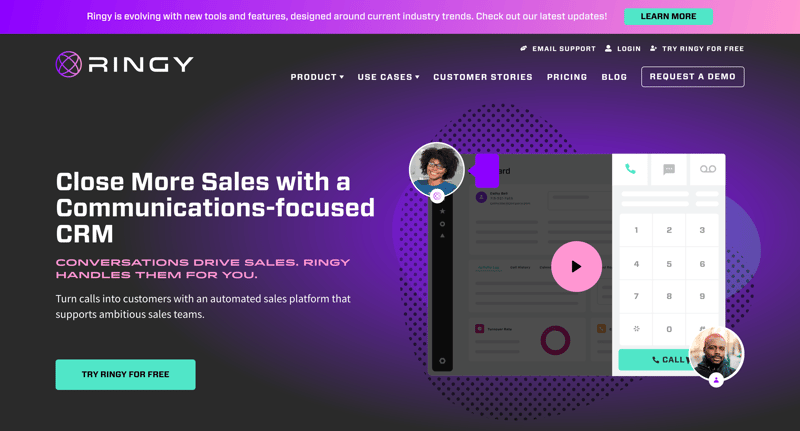
Ringy is a specialized marketing software tools for small business that bridges the divide between marketing outreach and sales closing. It unifies a virtual phone system for small business with automated SMS/MMS, VoIP, and a robust CRM. Unlike tools that just "send emails," Ringy focuses on high-touch, multi-channel engagement to ensure no lead goes cold.
Best For
- Sales-led small businesses that need to manage lead flow with immediate call center solutions for small business style follow-up.
- Businesses that have grown tired of paying "per-seat" for every new hire and want a predictable flat-rate model.
- Teams that require a VoIP phone systems for small business integrated directly into their marketing sequences.
Honest Limitations
While Ringy is a powerhouse for sales engagement, it is not a graphic design tool. If your primary goal is building complex, aesthetic-heavy newsletters (like a high-fashion brand might), you will likely need to pair Ringy with a design-focused app like Canva. Its focus is on conversion and communication velocity rather than artistic layout.
When to Choose Ringy
Choose Ringy if your marketing strategy relies on converting leads through active conversations. It is the perfect choice for marketing automation small business owners who want their "marketing" to end in a phone call or a text message exchange rather than just a click on a website.
Zoho CRM - Best For Integrated Business Ecosystems
Overview
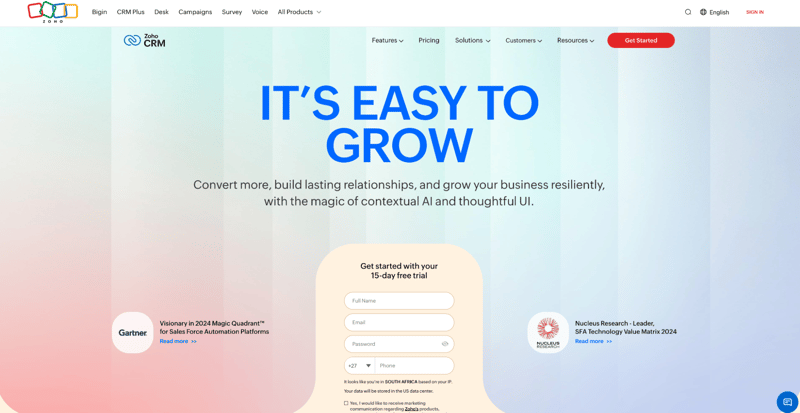
Zoho CRM is a flexible marketing management tools for small business that provides a wide array of built-in features, including social media management, email marketing, and AI-powered sales assistant "Zia." It is part of the massive Zoho One ecosystem, allowing it to connect to your accounting, HR, and project management tools.
Best For
- Budget-conscious teams that want an enterprise-level feature set at a small business price point.
- International businesses that need a multi-language and multi-currency digital marketing tools for small business solution.
- Tech-savvy owners who want to customize every field and workflow within their sales software.
Honest Limitations
The "Zoho ecosystem" is so vast that it can feel overwhelming for a true beginner. The user interface often feels "utilitarian" and slightly dated compared to the sleek, modern designs of competitors like Ringy or HubSpot.
Support can also be slower than dedicated, smaller firms when you are on the lower pricing tiers.
When to Choose Zoho CRM
Choose Zoho CRM if you are planning to run your entire business on a single software brand. If you value a "360-degree view" of your operations more than a fast, modern UI, Zoho provides the best breadth of features for the lowest per-user cost.
Salesforce Essentials - Best For Brand Credibility & Scalability
Overview
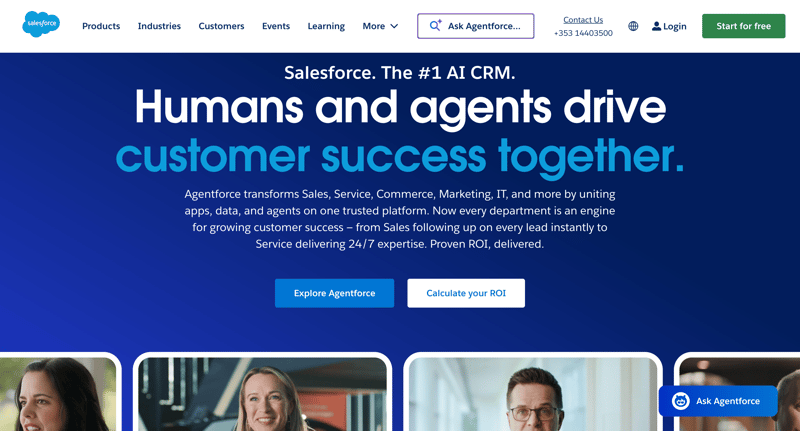
Salesforce Essentials is the "lite" version of the world's #1 CRM, designed specifically for teams of 10 or fewer. It provides a foundational understanding of customer relationship management while giving you access to the same powerful infrastructure used by Fortune 500 companies. It includes lead tracking, account management, and basic email integration.
Best For
- Small businesses that plan to grow into large enterprises and want to start on the industry-standard platform.
- B2B firms that need deep "account-based" marketing and sales visibility.
- Teams that have the technical capacity to manage a more complex, structured data environment.
Honest Limitations
Even the "Essentials" version of Salesforce has a steeper learning curve than almost any other marketing tools for small business. It lacks the built-in, flat-rate VoIP and SMS features that tools like Ringy offer natively, often requiring expensive third-party AppExchange integrations to achieve the same result.
When to Choose Salesforce
Choose Salesforce if you have a dedicated operations person to manage the CRM and your long-term roadmap includes complex data needs. It is less about "marketing speed" and more about "data integrity" for businesses that prioritize a rigid, scalable sales process.
Nimble - Best For Relationship & Social Marketing
Overview
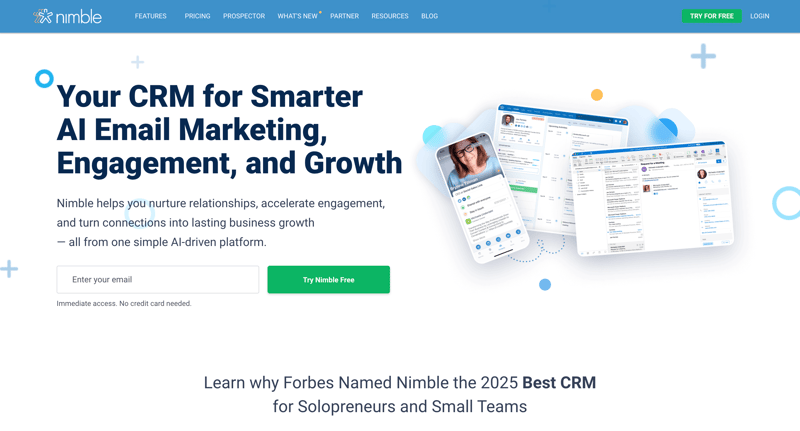
Nimble is a unique online marketing tools for small business that focuses on "Social CRM." It automatically pulls contact information, social profiles, and interaction history into a unified view. It "lives" inside your inbox and browser, meaning you don't have to keep a separate tab open to see who your prospects are and what they care about.
Best For
- Solopreneurs and consultants who rely heavily on social media (LinkedIn, Twitter) for lead generation.
- Users who spend their entire day in Outlook or Gmail and want a CRM that feels like part of their email.
- Relationship-driven marketers who value "context" over high-volume automation.
Honest Limitations
Nimble is not built for high-volume mass email service or automated outreach. If your marketing depends on managing thousands of anonymous leads, Nimble will feel underpowered. It is a tool for the "scalpel," not the "sledgehammer."
When to Choose Nimble
Choose Nimble if your marketing strategy is based on building deep, personal relationships with a few hundred key stakeholders rather than thousands of cold leads. It is the best tool for the modern social seller who values human connection above all else.
Keap - Best For Advanced E-commerce Automation
Overview
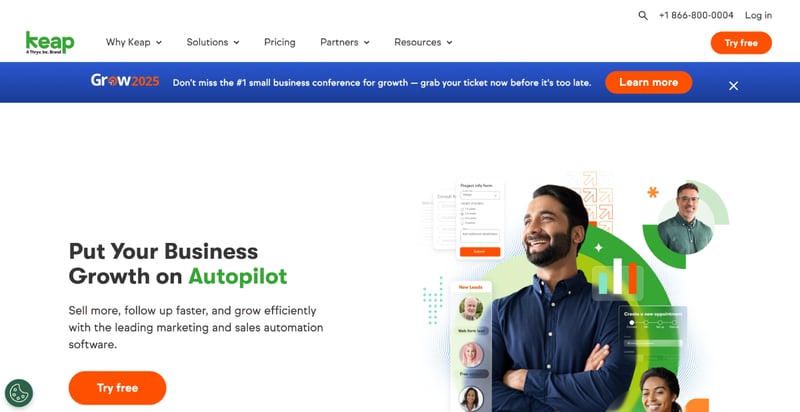
Keap (formerly Infusionsoft) is the "original" best marketing automation tools for small business. It is famous for its visual campaign builder that allows you to map out complex customer journeys with a drag-and-drop interface. It combines CRM, email, and billing into a single, high-powered engine.
Best For
- E-commerce businesses and service providers with long, multi-step sales cycles.
- "Infopreneurs" and coaches who need to automate webinar registrations, course sales, and follow-ups.
- Marketers who want to build a "hands-off" business that runs on complex logic.
Honest Limitations
Keap has been nicknamed "Confusionsoft" for a reason—its power comes at the cost of a significant learning curve. It is also one of the more expensive marketing software tools for small business on this list, often requiring a professional "implementation partner" to get your first major campaign live.
When to Choose Keap
Choose Keap if you are ready to "graduate" from basic email marketing and want to build a fully automated revenue machine. If you have a clear, proven sales funnel that just needs to be automated at scale, Keap is the heavyweight champion.
SurveyMonkey - Best For Marketing Research & Data
Overview
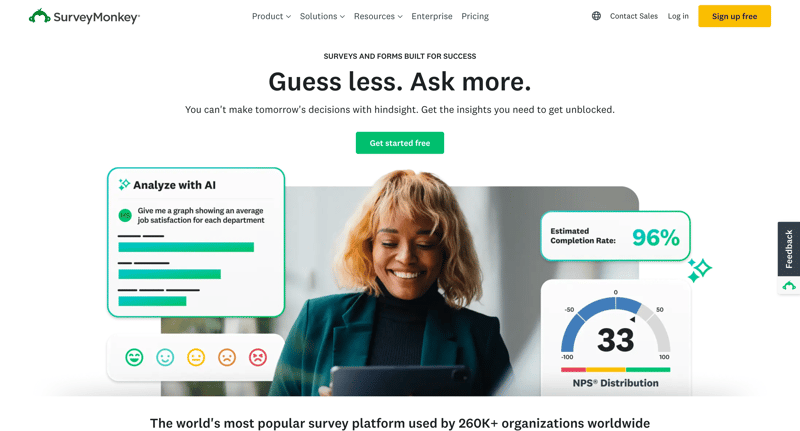
SurveyMonkey is the premier marketing research tools for small business. Understanding your customer's "why" is more important than just seeing their "what." It allows you to create professional surveys to gather feedback, conduct market research, and segment your audience based on actual psychographic data.
Best For
- Product-based businesses conducting beta testing or seeking feature requests.
- Service providers looking to automate Net Promoter Score (NPS) tracking.
- Marketers who want to use "quizzes" as a lead generation tool.
Honest Limitations
SurveyMonkey is a data collection tool, not a data action tool. It won't send your emails, dial your leads, or manage your social media. You must integrate it with a tool like Ringy or Zapier to turn those survey answers into actionable sales conversations.
When to Choose SurveyMonkey
Choose SurveyMonkey when you feel like you're guessing what your market wants. It is the best investment for businesses that want to stop wasting money on ads that don't resonate and start building products and messages based on actual customer voice.
Trello - Best For Marketing Project Management
Overview
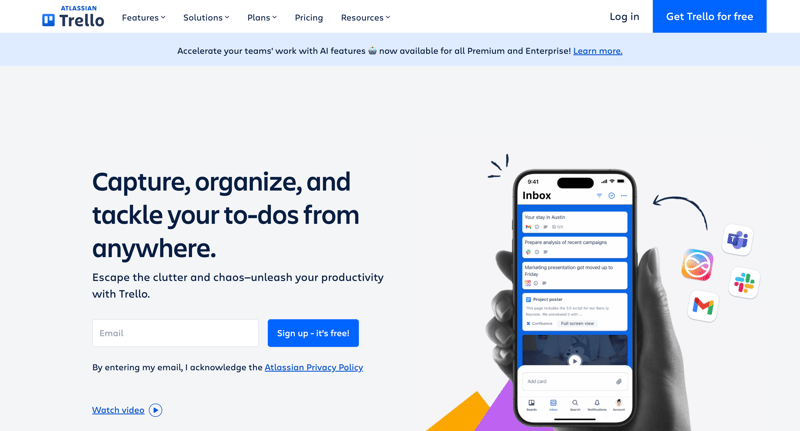
Trello is a visual top marketing automation tools for small business management aid that uses a "Kanban" board system. While not a direct "outreach" tool, it is essential for organizing content calendars, ad creative workflows, and campaign launches. It makes the "invisible" work of marketing visible to the whole team.
Best For
- Creative teams and agencies that need to track the "status" of different marketing assets.
- Visual learners who find traditional spreadsheet-based project management frustrating.
- Small teams that need a free or very low-cost way to stay organized.
Honest Limitations
Trello is very "open-ended," which can lead to chaos if you don't have a clear process. It doesn't have built-in CRM features or communication tools. If you need a tool that does the marketing for you, Trello is not it; it's the tool that helps you plan the marketing.
When to Choose Trello
Choose Trello if your biggest marketing problem is disorganization and missed deadlines. It is the best tool for the "chaos coordinator" who needs to see the entire marketing funnel on one screen to feel in control.
SEMrush - Best For SEO & Search Visibility
Overview
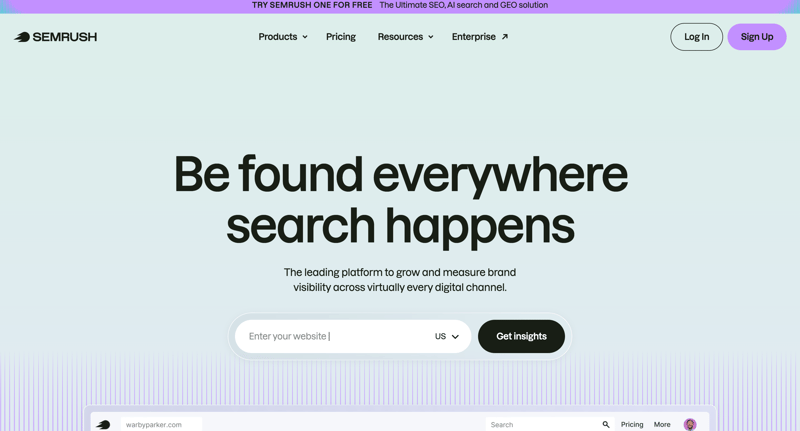
SEMrush is the "Swiss Army Knife" of online marketing tools for small business search strategy. It allows you to see exactly what keywords your competitors are ranking for, audit your own website for technical errors, and track your ranking progress in real-time.
Best For
- Businesses that rely on Google search for their lead generation.
- Content marketers who need to know exactly what topics will drive the most traffic.
- Competitive agencies that want to "spy" on their rivals' ad spend and backlink profiles.
Honest Limitations
SEMrush is expensive, starting at nearly $140/month. It also provides a massive amount of data that can be "noisy" if you don't know what you're looking for. It requires a baseline understanding of SEO to truly extract value from the investment.
When to Choose SEMrush
Choose SEMrush if you are committed to a long-term organic growth strategy. If you believe that "being found on Google" is the primary way your business will survive the next decade, this is a non-negotiable part of your stack.
Mailchimp - Best For Creative Email Campaigns
Overview
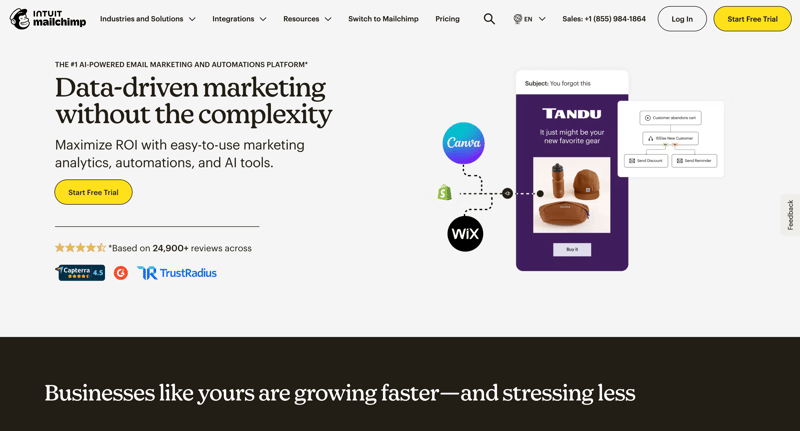
Mailchimp is the most recognizable best email marketing tools for small business. In 2026, it has evolved into a "Smart Marketing Platform" that includes website building, postcards, and AI-driven creative assistants. It is famous for its easy-to-use drag-and-drop email builder.
Best For
- Retail and lifestyle brands that need "beautiful" emails to sell visual products.
- Beginners who want a "guided" experience with plenty of templates and helpful tips.
- Non-profits and small groups that can take advantage of the generous free tier.
Honest Limitations
As your business grows, Mailchimp becomes remarkably expensive. Its pricing model is based on your total number of "contacts," including those who have unsubscribed. Its automation is also less flexible than specialized sales-focused tools like Ringy.
When to Choose Mailchimp
Choose Mailchimp if design and ease of use are your top priorities. It is the best starting point for a brand-new business that wants to look "big" from day one without hiring a professional designer.
Buffer - Best For Social Media Scheduling
Overview
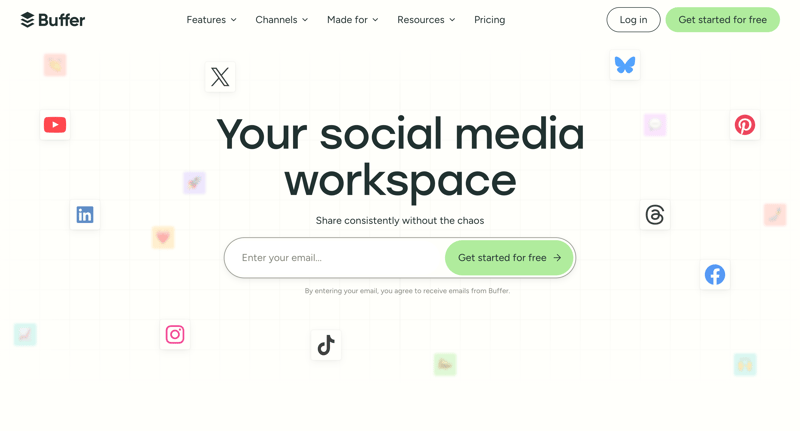
Buffer is a minimalist best online marketing tools for small business for social media management. It allows you to schedule posts for LinkedIn, Instagram, Facebook, and TikTok from one dashboard. It is designed to be "fast and out of the way."
Best For
- Small businesses that want a consistent social media presence without spending all day on their phones.
- Teams that manage multiple social brands or accounts and need to see them in one calendar.
- Marketers who want simple, easy-to-read engagement reports.
Honest Limitations
Buffer is a scheduling tool, not a "growth" tool. It won't help you find new followers or engage in deep "social listening." It also lacks a built-in CRM, meaning social leads often stay "stuck" on the platform unless you manually move them.
When to Choose Buffer
Choose Buffer if you find social media a "chore" and just want a simple way to stay consistent. It is the best choice for the "set it and forget it" marketer who values their time more than deep analytics.
Canva - Best For Production-Ready Ad Creative
Overview
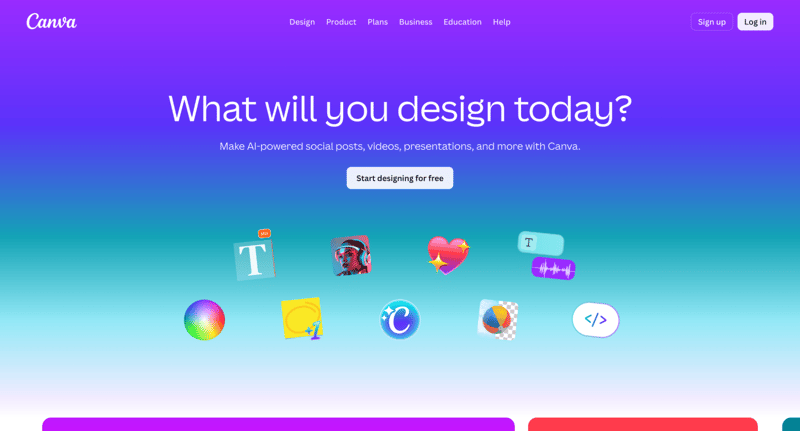
Canva has evolved into a comprehensive "Visual Suite" that allows small businesses to produce studio-quality marketing assets without a professional design team. In 2026, its "Magic Studio" leverages generative AI to turn simple text prompts into social media videos, presentations, and custom graphics instantly.
Best For
- Users who need to create high-quality Instagram Reels, TikToks, and YouTube thumbnails in minutes.
- Teams that need to rapidly test multiple visual hooks across different social platforms.
- Organizations that want to lock in brand colors, fonts, and logos across all employee-generated content.
Honest Limitations
While Canva is incredibly intuitive, it lacks the "surgical" precision of professional tools like Adobe Illustrator for complex vector work. Its built-in social media scheduler is often criticized by power users for having "bare-bones" analytics compared to dedicated platforms like Buffer. Additionally, the highest-tier AI features, like "Magic Switch," can occasionally produce generic-looking layouts that require manual tweaking to look authentically "on-brand."
When to Choose Canva
Choose Canva if you value speed and accessibility over raw technical power. It is the best choice for small businesses that need to maintain a high-frequency posting schedule across 5+ social channels without the overhead of a creative agency.
ManyChat - Best For DM-to-Sale Funnels
Overview
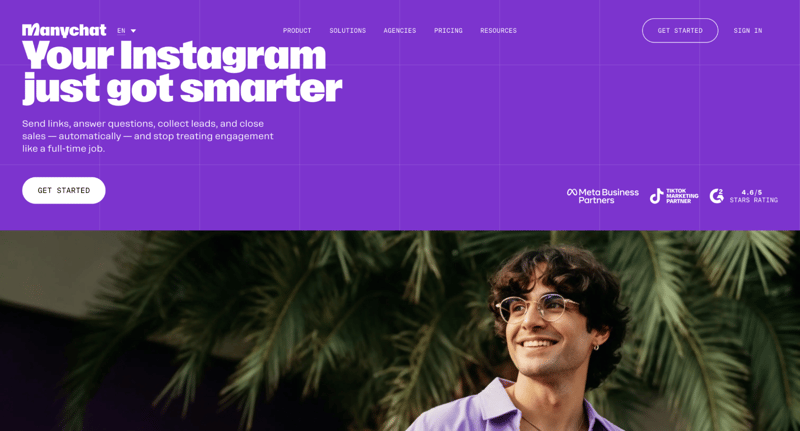
ManyChat is the leading platform for "Conversational Marketing," specifically optimized for Instagram, WhatsApp, and Facebook Messenger. It allows businesses to automate the "handshake" between a social media comment and a lead capture, effectively turning every story mention or post comment into an automated sales opportunity.
Best For
- E-commerce stores and creators who generate the majority of their leads through social engagement.
- Coaches or agencies that use "Keyword Triggers" (e.g., "Comment 'GROW' to get my guide") to build their email lists.
- Businesses that want to handle 80% of routine FAQs via chat before a human intervention is needed.
Honest Limitations
ManyChat's pricing is based on your total number of active subscribers, which can scale very quickly if you don't aggressively prune your list. While its "AI Step" can handle simple queries, it is not a fully autonomous sales agent; it still requires a structured "Flow" to move users toward a purchase. Complex flows can also become a "spaghetti" of logic that is difficult to debug if an automation breaks.
When to Choose ManyChat
Choose ManyChat if your goal is instant engagement.
If you find that your team is spending hours manually replying to "How much?" or "Link?" in your comments, ManyChat will automate that entire process, allowing you to focus on the high-value marketing automation small business strategy.
Considerations When Choosing Marketing Tools for Small Business

Selecting the right stack is a strategic decision that affects your team's daily happiness and your company's bank account. When you prioritize a "unified" stack over a "best-of-breed" stack, you significantly reduce the technical debt and data silos that kill small business growth.
Here are the five filters every owner should use.
|
Factor |
Key Consideration for Small Business Marketing Tools |
Example/Benefit |
|
Budget and Pricing Flexibility |
Look for flat-rate pricing or month-to-month contracts. |
Avoid "freemium" traps where costs spike after a small number of subscribers. Ringy's $119 flat rate is an example. |
|
Ease of Use and Learning Curve |
Prioritize tools with high "Time to Value" (TTV). |
The team should see a result within the first few hours of logging in. Avoid tools requiring extensive, 40-hour certifications. |
|
Integration with Existing Systems |
Tools must communicate with each other easily. |
Look for native Zapier integrations or "one-click" connections to email providers and payment processors. A disconnected CRM is useless. |
|
Features That Match Business Goals |
Be honest about where your revenue comes from. |
If you close deals by phone, choose a communication-focused CRM (like Ringy). If via search, choose an SEO tool. |
|
Scalability as the Business Grows |
Choose tools that can handle both small and large lead volumes. |
Select tools that can easily manage 10 leads or 10,000 leads. Avoid "niche" tools without a path to enterprise-level features. |
Frequently Asked Questions

This section provides answers to the most common questions small business owners have about selecting and implementing the right marketing tools. We aim to clarify the various options available and help you make informed decisions to maximize your marketing impact.
What Are the Best Marketing Tools for a Small Business on a Budget?
For those just starting, the combination of Ringy (flat-rate sales automation), Canva (free design), and Buffer (free social scheduling) provides a world-class marketing engine for under $120/month. This "trinity" covers communication, creative, and distribution without the high cost of an all-in-one suite.
Why Are AI Marketing Tools for Small Business So Popular in 2026?
AI has become the "great equalizer." It allows a team of one to produce the content volume of a team of ten. Tools like Ringy use AI to predict which leads are most likely to close, while tools like Canva use AI to generate professional graphics in seconds.
Do I Really Need a CRM if I'm a Small Business?
Yes. A CRM is the "brain" of your marketing. Without it, you are guessing who to follow up with, when to send an email, and which of your marketing efforts are actually making money. A communication-focused CRM like Ringy is especially vital for ensuring no lead is ever left behind.
What Is the Difference Between Marketing Automation and Email Marketing?
Email marketing is the action of sending a message. Marketing automation is the logic that decides when to send that message based on user behavior. Automation is: "If a user clicks this link but doesn't buy, wait two days and send them a 10% discount code via text."
Can I Manage My Own Digital Marketing With These Tools?
Absolutely. Modern digital marketing tools for small business USA are designed specifically for the non-technical owner. With "one-click" templates and AI-powered assistants, the technical barrier to entry has vanished.
Marketing Tools for Small Business: Align Your TechStack the Right Way
If you're ready to stop juggling five different apps and want a unified, sales-driven marketing engine that actually moves the needle, it's time to see what a specialized CRM can do.
Sign up for a free trial to test our software
It's built for the small business owner (like you) who values results over "vanity metrics."

Skyrocket your sales with the CRM that does it all.
Calling? Check. SMS? Check. Automation and AI? Check. Effortlessly keep in touch with your customers and boost your revenue without limits.

Related Articles