 Updated on
 By Rob Marquez
Table of Contents

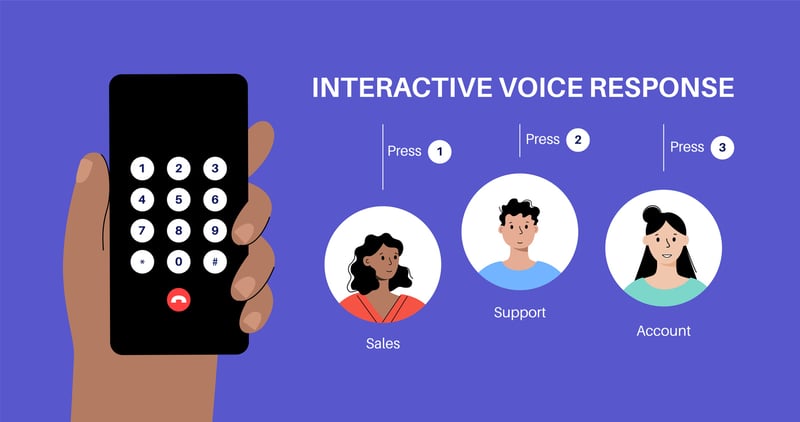
You've likely been there: you dial a customer service line, ready to resolve a simple billing issue, only to be met with a labyrinth of "Press 1 for Sales" and "Press 2 for Support" that never seems to end. In the fast-paced world of sales and customer service, every second your caller spends lost in a phone tree is a second they are moving closer to hanging up in frustration.
The problem for many businesses is that their phone systems act more like a barrier than a bridge. You need a way to route high volumes of calls to the right people without hiring a small army of receptionists, yet your current setup might be outdated, confusing, or, worst of all, completely manual.
This operational drag doesn't just frustrate your callers; it eats into your margins and burns out your best agents who end up answering the same basic questions over and over again. The agitation grows when you realize that while your team is stuck handling "what is my balance" calls, your high-value leads are sitting in a queue, losing interest by the minute.
If your virtual call center software doesn't have a smart way to triage these requests, you aren't just losing time; you're losing revenue.
The solution is a deep understanding and implementation of a modern IVR system. When used correctly, IVR transforms your phone line into an intelligent, 24/7 receptionist that can authenticate users, process payments, and route complex inquiries with surgical precision.
This guide breaks down the full IVR meaning, showing you how to turn a potentially frustrating "phone tree" into a seamless, revenue-driving asset for your business.
Key Takeaways
- IVR Definition: An automated telephony system that interacts with callers through voice or keypad inputs to route calls or provide information.
- Core Benefits: Drastically reduces operational costs, provides 24/7 self-service, and improves lead routing for sales teams.
- Technical Flow: Uses DTMF (keypad) and NLP (voice) to gather data before directing the call to a live agent or database.
- Modern Trend: Shifting toward "Conversational IVR" using AI to understand full sentences rather than just simple commands.
What Is IVR? Definition and Core Functionality

Interactive Voice Response (IVR) is an automated telephony technology that allows a computer to interact with humans through the use of voice and DTMF (Dual-Tone Multi-Frequency) tones input via a keypad, typically used to route calls or provide self-service options.
An IVR phone meaning refers to the "electronic receptionist" that greets you when you call a large company. It uses a combination of pre-recorded messages and text-to-speech technology to present options.
When a caller hears a prompt and responds, the system analyzes that input to decide the next step, whether that's providing an account balance, asking for an IVR pin meaning, or transferring the call to a specialized sales agent.
The meaning of IVR goes beyond just being a menu; it is an interaction engine.
Why IVR Exists
In the early days of telephony, every call had to be manually patched through by a human operator. As businesses scaled, this became impossible. The interactive voice response IVR meaning represents the digital evolution of that operator. It exists to solve three primary business pain points:
- Cost Reduction: Automating routine questions (like "What are your hours?") means you don't have to pay an agent to say the same thing 50 times a day.
- Faster Routing: A well-designed IVR menu means getting the caller to the person who can actually help them on the first try, eliminating the "let me transfer you" merry-go-round.
- Scalable Support: Your IVR can handle thousands of simultaneous calls, whereas a human receptionist can only handle one. This is critical for maintaining a professional cloud-based calling presence during peak hours.
While the technology behind IVR is complex, the goal is simple: to make your customers' experience as smooth, fast, and helpful as possible. It's the silent assistant working tirelessly in the background, ensuring that no matter how busy you are, every person who calls feels valued and gets the attention they need.
IVR System Meaning: How IVR Works Behind the Scenes
When we look at the IVR system meaning, we are looking at a stack of technologies working in concert. It isn't just a recording; it's a gateway that connects your phone lines to your company's databases.
Understanding what is IVR meaning in a technical context reveals a sophisticated workflow that bridges telephony and software.
Core Components of an IVR System
An IVR phone system meaning relies on several technical pillars to function effectively:
- Call Routing Engine: The logic that decides where a call goes based on the "rules" you've set up (e.g., if "Sales," then route to "Ringy Sales Group").
- Voice Prompts: The audio files that play for the caller.
- DTMF Recognition: The tech that understands which button you pressed (the "beeps").
- Speech Recognition: Modern voice IVR meaning includes AI that can understand spoken words like "representative" or "billing."
- Integrations with CRM or ticketing systems: This is where the magic happens. The IVR can "look up" a caller's number in a database and greet them by name.
At the end of the day, an IVR system isn't just a complicated piece of technology; it's the digital front door to your business.
When done right, it makes your customers feel heard, routes them quickly to the right person, and ensures that even the most complex calls start with a sense of clarity and ease.
Technical Flow of a Call
The IVR call meaning starts the second the system answers. The caller hears a greeting, then provides input. The system then performs a "look up" , perhaps verifying an IVR account number meaning, and finally executes an action. This action could be playing a message, like an IVR balance inquiry meaning, or handing the call off to a human. For those using telephony solutions, this flow is the backbone of the customer journey.
Benefits of IVR Systems
Implementing a robust IVR system for call centers means delivering measurable ROI by optimizing how your humans and your hardware interact. The IVR experience meaning for a customer can be drastically improved when the system is optimized to handle high-volume queries without human intervention.
|
Feature |
Standard IVR |
Conversational IVR |
|
User Interaction |
Relies on the phone keypad (DTMF) for input. Users are prompted with specific menu options (e.g., "Press 1 for Sales"). |
Allows users to speak naturally. Prompts are open-ended (e.g., "How can I help you today?"). |
|
Logic |
Predefined, rigid, and linear decision tree. Users are looped back or disconnected if they stray from expected input. |
Intent-based and non-linear approach powered by AI and NLP. Understands user's intent regardless of specific phrasing. |
|
Customer Satisfaction |
Functional and average. Can be frustrating due to long menus and lack of flexibility. |
High and intuitive. Users appreciate the speed and ease of bypassing complex trees. |
|
Integration Complexity |
Moderate. Straightforward setup using standard telephony systems. |
High. Requires integration with sophisticated AI and NLP engines for accurate speech processing. |
Now, let's look at some additional advantages.
Reduced Operational Costs
By automating repetitive inquiries, you slash your cost-per-call. If 30% of your calls are simple status checks that an IVR message can handle, you effectively increase your staff's capacity by 30% without hiring a single person.
This is why IVR is often synonymous with business efficiency.
Beyond just reducing the need for additional staff, this increase in capacity allows your existing agents to focus on more complex, high-value customer interactions that require human empathy and problem-solving skills. This improves job satisfaction for your agents and leads to a higher quality of service for customers with critical issues, ultimately boosting overall customer satisfaction and loyalty.
Shorter Wait Times & Improved Routing
Nothing kills a sales call faster than a long hold time.
An IVR system in a call center setup ensures that high-priority leads are identified and segmented based on their input choices (e.g., pressing a specific number for "Sales Inquiry" or "New Business").
This automated identification process allows these valuable leads to be fast-tracked, bypassing standard queues and immediately routing them to your top closers or most experienced sales agents.
This optimization significantly increases the speed of lead engagement, improves the customer experience for high-value prospects, and boosts conversion rates for time-sensitive opportunities.
24/7 Self-Service Capabilities
Your agents need to sleep, but your IVR telephony system doesn't. Whether a customer needs to check a payment or find an IVR pin meaning, they can do it at 3 AM without any human intervention. This is a staple of IVR banking, meaning where security and 24/7 access are paramount.
Increased Agent Productivity
When agents aren't bogged down by "Where is my order?" calls, they can focus on complex, high-value tasks. This reduces burnout and allows them to utilize AI marketing tools and other sophisticated resources to close deals.
Challenges and Limitations of IVR

While the IVR phone meaning implies convenience, poorly designed systems can create a "phone tree from hell." The IVR system's meaning can sometimes be lost if the user feels they are trapped in a loop.
Such as:
- User frustration with long menus: If you have more than 5 options, callers will forget the first one by the time you reach the fifth.
- Speech recognition errors: Background noise or heavy accents can confuse older voice IVR meaning systems.
- Overly complex multi-level IVR trees: When a caller has to navigate four sub-menus to find an IVR option's meaning, they are likely to hang up.
To solve these, modern IVR technology focuses on keeping menus short, integrating natural language processing, and always offering a "Press 0" escape to a live agent. Understanding the IVR prompts' meaning allows you to refine these paths using analytics to see where callers drop off most frequently.
Industry Use Cases: How Different Sectors Use IVR
The IVR meaning changes slightly depending on the industry, but the goal of efficiency remains the same. The IVR meaning in work scenarios across various verticals shows just how versatile this technology has become.
|
Industry |
Primary IVR Number Meaning |
Key Features |
Explanation |
|
Banking & Financial Services |
IVR banking meaning |
Balance inquiry, Fraud alerts, Loan status, IVR authentication |
IVR systems in this sector allow customers to manage their accounts, check balances, get loan status updates, report fraud, and use multi-factor IVR authentication for secure access. |
|
Telecom |
IVR meaning in telecom |
Plan changes, Data usage, Billing automation |
Telecom IVR handles high call volumes for tasks such as automated bill payment and inquiries, checking remaining data or minutes, and managing service plan upgrades or downgrades. |
|
Insurance |
IVR insurance meaning |
Claims reporting, Premium lookup, Agent routing |
Insurance IVR facilitates automated claims reporting and status checks, provides policy information, enables premium payments/lookup, and directs complex queries to the appropriate agent. |
|
Healthcare |
IVR medical meaning |
Appointment reminders, Prescription renewals, Lab result requests |
Medical IVR systems are used for automated appointment scheduling and reminders, simplifying the process for prescription refills, and securely providing access to lab result requests. |
|
SaaS & Subscription Services |
IVR account meaning |
Account lookup, Billing updates |
IVR for SaaS companies helps customers quickly look up account details, manage subscription billing, and troubleshoot common issues without agent intervention. |
Now, let's take a brief look at each of these verticals.
Banking & Financial Services
In the financial world, IVR's meaning in finance is centered on security and speed. Banks use IVR authentication to verify a caller's identity before revealing sensitive data, often requiring an IVR PIN, meaning or voice biometrics.
Beyond security, the IVR banking meaning revolves around providing 24/7 access to funds. This includes automated IVR balance inquiries, as well as the ability to report lost or stolen cards instantly.
By moving these high-frequency, low-complexity tasks to an automated system, banks can reserve their human tellers and advisors for complex financial planning and loan negotiations.
Telecom
For cellular and internet providers, IVR meaning in telecom is about managing massive call volumes during peak hours or outages. These systems are designed to handle routine account maintenance without ever involving a live representative.
Common IVR phone meaning applications in telecom include:
- Billing Automation: Allowing users to pay their monthly statements via the keypad.
- Data Usage Tracking: Providing real-time updates on remaining gigabytes or minutes.
- Plan Upgrades: Using a multi-level IVR means guiding users through new promotional offers and service changes.
While IVR technology is a powerful tool for efficiency and scale, it's the bridge between a user's need and a quick solution, ensuring that when you do need to speak with a person, the representative can focus on the complex, human-centered innovation and issues that matter most.
Insurance
For insurance providers, IVR insurance's meaning is primarily about the speed of claims processing. When an accident occurs, the policyholder wants immediate confirmation that their report has been received.
An IVR, meaning insurance setup, often utilizes DTMF IVR, meaning (keypad inputs) to categorize the type of claim—auto, home, or life—and its severity. This allows the system to perform IVR routing, meaning that it puts the caller in touch with the exact department capable of handling their specific crisis.
It also facilitates a "premium lookup" feature so customers can check their payment status without waiting in a queue.
Healthcare
The IVR medical meaning often revolves around clinical coordination and appointment management. In a healthcare setting, the IVR system must be reliable and strictly compliant with privacy regulations.
Patients typically interact with the system through:
- Appointment Reminders: Reducing the rate of "no-shows" by allowing patients to confirm or reschedule via the phone menu.
- Prescription Renewals: Connecting the IVR to the pharmacy database to process refill requests automatically.
- Lab Result Requests: Providing a secure way for patients to receive simple test outcomes through IVR authentication.
SaaS & Subscription Services
For software-as-a-service companies, the IVR phone system is a vital part of the technical support ecosystem. SaaS firms often deal with high-volume, low-complexity technical questions that don't always require a developer's attention.
Implementing an IVR account allows for rapid account lookups and billing updates. For example, if a user's credit card expires, an automated IVR message can guide them through the update process. This keeps the sales software funnel moving and prevents churn by resolving billing friction points autonomously.
Designing an Effective IVR Menu: Best Practices

A poorly designed IVR menu meaning is a "phone tree from hell." To avoid this, you must follow strict UX (User Experience) principles. The IVR call centre meaning should be synonymous with "help," not "hurdle."
Here's the 10-step IVR menu design process:
- Research: Analyze your call logs to see why people are actually calling.
- Mapping: Use a flow chart to visualize every possible path a caller can take.
- Scripting: Write short, punchy IVR prompts meaning, "For Sales, press 1" is better than "If you would like to speak to a member of our sales team... Please press 1."
- Prioritize: Place the most frequently used IVR options, meaning at the top of the menu.
- Language: Use natural, human-sounding language where possible.
- Accessibility: Design for non-tech users by keeping options simple.
- Shortness: Keep total prompt length under 30 seconds.
- Escalation: Always offer a shortcut to speak to an agent.
- Testing: Call into your own system to find ambiguities.
- Optimization: Use analytics to refine menu paths over time.
Keep your menus under 5 options. Most people cannot remember more than four items in a list. If you provide nine choices, the caller will forget the first three by the time you reach the last one, leading to frustration and "spamming zero" to find an agent.
The Future of IVR: Trends & Innovations
The traditional IVR system, characterized by long, frustrating menus and repetitive "Press 1 for..." instructions, is rapidly becoming obsolete.
Today's IVR is a sophisticated, AI-driven customer experience engine that dramatically cuts down on hold times, improves first-call resolution, and provides a smoother, more personalized experience.
The modern IVR is no longer just a digital receptionist; it is a core component of the customer service infrastructure, integrating seamlessly with CRM, web analytics, and other enterprise systems. This new generation of technology is redefining what a phone call to a business means.
Here are the four key innovations defining the future of the IVR system:
- Voice Biometrics: Your voice becomes your IVR pin, meaning it allows "passwordless" authentication. This dramatically reduces call time and frustration by eliminating the need for customers to remember and key in account numbers, security questions, or temporary PINs. It verifies the caller's identity securely and instantly.
- Predictive Routing: If a user just looked at a "cancel subscription" page and then calls in, the IVR, meaning phone system, can route them to a retention specialist immediately. By integrating with the CRM and web analytics, the IVR anticipates the customer's need before they state it. This ensures they are connected to the right agent with the necessary context, leading to a higher first-call resolution rate and better outcomes.
- Visual IVR Meaning: Some companies now send a link to your smartphone during the call, allowing you to navigate a visual menu on your screen while staying on the line. This merges the convenience of a website with the support of a phone call. Customers can upload documents, check account balances, or select complex menu options via a touchscreen interface, bypassing the need to listen to and press long DTMF sequences.
- Conversational IVR: Moving away from DTMF IVR meaning and toward natural dialogue using AI to understand intent. Utilizing Natural Language Understanding (NLU), this allows customers to speak their needs naturally ("I need to change my billing address") rather than following a rigid script ("Press 1 for Sales, Press 2 for Support..."). The AI can handle common queries end-to-end without agent intervention.
These innovations collectively signal a significant shift in how companies approach customer interaction. By prioritizing a seamless, personalized, and efficient experience, the next-generation IVR transforms a traditionally frustrating touchpoint into a powerful channel for customer satisfaction and loyalty. The future of IVR is smart, connected, and ultimately, focused on getting the customer what they need, faster.
IVR Meaning: Final Thoughts

Understanding the full IVR meaning is the difference between a business that scales and one that stays stuck in the manual past. By implementing a smart IVR system, you aren't just automating a phone line; you are engineering a better customer experience and a more profitable sales floor. Whether you are using it for IVR balance inquiry meaning or complex sales routing, the goal is clarity, speed, and reliability.
Don't let your valuable leads wither away in a poorly designed phone tree.
Take control of your telephony and show your callers that you value their time as much as their business.
Ready to see how our intelligent IVR can transform your sales cycle?
Schedule a demo with Ringy today and discover how our integrated CRM and automation platform can help you close more deals with a professional, high-converting phone system.

Skyrocket your sales with the CRM that does it all.
Calling? Check. SMS? Check. Automation and AI? Check. Effortlessly keep in touch with your customers and boost your revenue without limits.

Related Articles










.jpg)

.jpg)



















.jpg)