 Updated on
 By Carlos Correa
Table of Contents

Imagine finding a $100 bill on the sidewalk. You would likely feel a pleasant surge of excitement. Now, imagine losing $100 from your wallet through a hole in your pocket. The sting of that loss feels significantly sharper than the joy of the unexpected find.
This psychological quirk is known as loss aversion. It is a fundamental concept in behavioral economics that influences how we shop, invest, manage relationships, and advance our careers. It explains why we hold onto failing projects, panic during market dips, and fall for "limited-time offers."
This guide breaks down the loss aversion meaning, how loss aversion theory works, and shows how businesses and sales teams use loss aversion bias to influence decisions ethically and effectively.
Key Takeaways
- Losses Feel More Powerful Than Gains: Loss aversion bias explains why people react more strongly to losing $100 than gaining $100. This emotional imbalance affects purchasing decisions, investing behavior, customer retention, and sales conversations across nearly every industry.
- Businesses Use Loss Aversion Constantly: Limited-time offers, free trial expiration notices, and low-stock alerts are all based on loss aversion theory. Companies use these tactics to create urgency and reduce customer hesitation without necessarily lowering prices.
- Sales Teams Can Use Loss Aversion Ethically: The best sales professionals focus on helping prospects avoid real business risks like missed leads, slow follow-ups, or lost revenue. Sales tools like Ringy support this process with automation, lead tracking, and faster outreach workflows.
- Loss Aversion Impacts Long-Term Decisions: People often stay in bad jobs, hold losing investments too long, or avoid necessary risks because the fear of losing feels more immediate than the possibility of future gains.
- Awareness Helps Reduce Bias: Understanding what loss aversion is can help consumers, marketers, and business leaders make more objective decisions using data, long-term thinking, and structured evaluation frameworks.
What Is Loss Aversion?

Loss aversion is a psychological principle that describes how people feel the pain of losses more strongly than the pleasure of equivalent gains. In behavioral economics, losing something often creates a larger emotional response than gaining something of equal value.
In simple terms, it hurts more to lose something we already own than it feels good to acquire something new of equal value.
What Is Loss Aversion Bias?
Loss aversion bias is the tendency to avoid losses even when taking a risk could lead to better long-term outcomes. This cognitive bias influences decisions in investing, sales, relationships, career choices, and consumer behavior because people prioritize emotional safety over potential reward.
How Loss Aversion Theory Works
To understand what is loss aversion, we must look at how our brains calculate value. Traditional economic models assumed humans were completely rational actors who evaluated choices based on absolute outcomes. If you had a 50/50 chance of winning $110 or losing $100, a purely rational actor would take that bet every time because the expected value is positive.
However, loss aversion theory proves that we do not evaluate value symmetrically. The psychological weight of the potential $100 loss completely eclipses the excitement of the $110 gain.
The Origins of Loss Aversion Theory
The concept was first formally identified by psychologists Amos Tversky and Daniel Kahneman in their seminal 1979 paper on Prospect Theory. They observed that when people face risk-related choices, they evaluate gains and losses relative to a specific reference point rather than their net wealth.
Kahneman and Tversky conducted numerous experiments showing that people routinely reject fair bets because of an inherent aversion to losing. Their research fundamentally altered how economists view human behavior, proving that our financial choices are deeply tethered to survival-driven emotional responses.
Understanding the Loss Aversion Graph
The easiest way to conceptualize this bias is by looking at a loss aversion graph, which plots objective value (gains and losses) against subjective value (how good or bad it feels).
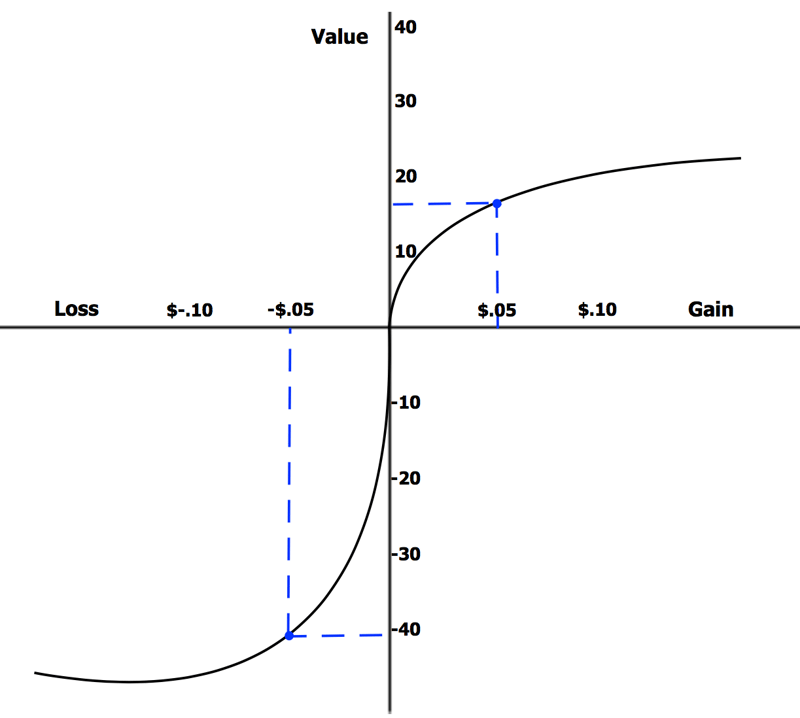
As the graph illustrates, the value function is S-shaped and asymmetrical. Crucially, the curve is significantly steeper for losses than it is for gains.
- If you gain $50, your psychological utility goes up by a moderate amount.
- If you lose $50, your psychological utility drops dramatically.
Statistically, studies suggest that the coefficient of loss aversion is typically between 1.5 and 2.5. This means a loss hurts about twice as much as an equivalent gain pleases us.
Why Small Losses Feel Bigger Than Small Wins
From an evolutionary perspective, this asymmetry kept our ancestors alive. In a hunter-gatherer society, a small gain (finding an extra bush of berries) meant a slightly more comfortable day. A small loss (losing a day’s worth of clean water or shelter), however, could mean death.
Our brains evolved to prioritize threat detection and loss prevention over reward seeking. Humans naturally attach emotional value to what they already possess. Once ownership forms, the fear of losing that thing intensifies.
This is why:
- Investors hold losing stocks too long
- Customers hesitate to cancel subscriptions after setup
- Businesses resist replacing outdated systems
- Consumers overvalue products they already own
Psychologists sometimes call this the "endowment effect," which overlaps heavily with loss aversion bias.
The emotional weight of loss also increases under uncertainty. When outcomes feel unclear, people default toward safer decisions, even if those decisions hurt them long term.
Loss Aversion Examples in Everyday Life

The following are some excellent examples of loss aversion in our lives.
1. Loss Aversion Examples in Shopping
Modern ecommerce relies heavily on loss aversion examples to increase conversions.
Common tactics include:
- Free trials ending soon
- Limited-time discounts
- "Only 2 left in stock"
- Flash sales
- Cart abandonment reminders
- Loyalty points expiration notices
These strategies work because consumers fear missing opportunities.
For example, a customer may delay buying software for weeks. But once they see "Offer expires tonight," the emotional pressure increases because inaction suddenly feels like losing something valuable.
Platforms like Ringy help sales teams reduce lost opportunities through:
- Automated follow-up reminders
- SMS outreach
- Email sequences
- Pipeline tracking
- Lead prioritization
Instead of letting prospects disappear silently, teams can re-engage buyers before opportunities go cold.
2. Loss Aversion Example in Investing
Many investors refuse to sell declining stocks because selling makes the loss feel "real." Instead, they hold onto losing positions, hoping prices rebound.
At the same time, investors often sell winning stocks too early because they fear losing profits.
This creates irrational decision-making patterns like:
- Panic selling during market drops
- Avoiding healthy risks
- Chasing short-term safety
- Ignoring long-term strategy
Loss aversion theory explains why emotional investing frequently outperforms logic in high-pressure situations.
3. Loss Aversion Examples in Relationships
We see this bias play out in our personal lives when people stay in unfulfilling or toxic relationships because they focus on the time, energy, and years they have already "invested."
Ending the relationship means accepting that those years are gone, which feels like a catastrophic loss. Walking away requires confronting an uncertain future, so many choose the familiar, painful present over the potential of a happier tomorrow.
Loss Aversion in Career Decisions
Employees frequently remain in jobs they dislike because they fear losing:
- Stable income
- Benefits
- Predictability
- Reputation
- Workplace relationships
Similarly, entrepreneurs may delay launching businesses because the fear of failure outweighs potential success. The result is often long-term stagnation caused by short-term emotional protection.
How Businesses Use Loss Aversion in Marketing

When it comes to marketing, here’s how some businesses use loss aversion to persuade their customers.
Why Loss-Based Messaging Converts Better
Loss-focused messaging usually creates stronger emotional urgency than gain-focused messaging.
Compare these two headlines:
- "Increase your sales pipeline."
- "Stop losing qualified leads."
The second version feels more urgent because it frames the problem as an active loss.
Businesses use this approach because humans instinctively prioritize protection over growth.
This principle appears in:
- Cybersecurity marketing
- Insurance ads
- SaaS onboarding
- Ecommerce promotions
- Financial services sales
Sales Tactics Built Around Loss Aversion Bias
Many sales tactics intentionally leverage loss aversion bias.
Common examples include:
|
Tactic |
Psychological Trigger |
|
Countdown timers |
Fear of missing out |
|
Limited inventory |
Scarcity |
|
Expiring discounts |
Urgency |
|
Exclusive access |
Fear of exclusion |
|
Free trial endings |
Loss of ownership |
These strategies can be ethical when they reflect genuine limitations or real customer risks. But manipulative usage happens when businesses create fake urgency or misleading scarcity.
To execute this smoothly, sales teams need to act while the prospect’s interest is genuine. Ringy’s pipeline automation helps sales teams respond quickly before prospects lose interest or drift away. When a lead interacts with an expiring offer, Ringy ensures a sales rep is instantly notified to guide them through the process, providing real-time, helpful interaction right when it matters most.
How SaaS Companies Use Loss Aversion
Software-as-a-Service (SaaS) businesses rely heavily on long-term subscriptions, making customer retention their primary metric. To keep churn low, they design onboarding sequences specifically engineered to build emotional ownership early on.
This includes:
- Data migration
- Personalized dashboards
- Workflow customization
- Integrations
- Team collaboration setups
Once customers invest time configuring a platform, switching becomes psychologically painful. That’s why retention improves after onboarding completion.
Ringy supports this process with:
- CRM integrations
- Automated outreach
- Lead tracking
- Contact management
- Workflow automation
These features help businesses create operational consistency that customers become reluctant to lose.
Cart Abandonment and Fear of Missing Out
Cart abandonment campaigns rely heavily on loss aversion theory.
Examples include:
- "Your cart expires in 2 hours."
- "Items are selling fast."
- "Prices may increase soon."
- "Complete your purchase before stock runs out."
These reminders work because they transform passive browsing into a perceived potential loss.
Fear of missing out (FOMO) is essentially a modern application of loss aversion bias.
How Sales Teams Can Use Loss Aversion Ethically

Sales professionals don't need to rely on high-pressure tricks to close deals. By utilizing loss aversion ethically, you can help prospects clearly see the hidden risks of staying with their status quo.
Focus on Real Customer Risks
Instead of just pitching how great your product is, ask discovery questions that uncover what your prospect stands to lose if they change nothing.
- "How much revenue are you losing each quarter because of missed lead follow-ups?"
- "What is it costing your team in manual labor hours to patch together your current systems?"
Use Data to Quantify Potential Losses
Vague warnings don't move the needle, but concrete data does. Use industry benchmarks, ROI calculators, and case studies to put a clear dollar figure on their inefficiencies. Showing a business owner that their outdated software is costing them $4,500 per month turns a vague problem into an active financial leak that they will want to plug immediately.
Improve Follow-Ups Before Leads Go Cold
Many sales opportunities disappear simply because follow-up timing is inconsistent.
However, a platform like Ringy helps reduce lead loss with:
- Automated SMS campaigns
- Email sequences
- Power dialing
- Appointment reminders
- CRM activity tracking
These features allow teams to maintain consistent engagement without manually managing every interaction.
Build Customer Ownership Early
The earlier customers emotionally invest in a product, the stronger retention becomes. Businesses can encourage ownership through:
- Personalized onboarding
- Custom workflows
- Product setup assistance
- Team collaboration features
- Progress tracking
When customers feel invested, leaving the platform feels like losing the value they already built.
Common Mistakes Caused by Loss Aversion
While understanding this bias is a superpower for business growth, failing to recognize it in your own decision-making can lead to costly strategic blunders.
- Holding Onto Bad Decisions Too Long: Whether it's a marketing campaign that isn't converting, a bad hire, or a product line that isn't selling, we often pour more money into failing initiatives simply because stopping means admitting defeat and absorbing a definitive loss.
- Avoiding Necessary Risks: True business growth requires calculated risk. However, loss aversion bias can cause leadership teams to become overly protective of their current market share, rejecting innovative new ideas or expansions because they are afraid of minor short-term losses.
- Overreacting to Temporary Losses: In business and investing, downturns happen. Leaders affected by loss aversion often panic during minor market corrections or slow quarters, making rash cuts to core assets, marketing budgets, or vital staff, which severely damages long-term recovery.
- Ignoring Better Opportunities: By fixating on defending what you currently have, you miss out on massive opportunity costs. Spending all your energy maintaining a low-margin legacy system prevents your team from building high-margin, scalable solutions for the future.
How to Overcome Loss Aversion Bias
Recognizing the bias is half the battle; building systems to neutralize it is the other half. Here is how you can ensure your decisions are guided by logic rather than fear.
- Reframe Decisions Around Long-Term Outcomes: When faced with a difficult choice, consciously shift your timeline. Instead of asking, "What do I lose today if I make this change?" ask yourself, "Where will my business be two years from now if I stick with my current setup versus making this transition?" Reframing the choice around long-term opportunity costs strips away the emotional sting of short-term losses.
- Use Data Instead of Emotion: When reviewing strategies, look directly at cold, hard metrics like ROI tracking, conversion rates, and revenue forecasting. What do the numbers say about our trajectory over the next fiscal year?
- Break Big Decisions Into Smaller Steps: If a major transition feels too risky, break it down into smaller, low-stakes milestones. Instead of migrating your entire enterprise software stack overnight, run a pilot program with a single department.
Practical Strategies to Apply Loss Aversion Today

Here are some practical strategies to apply loss aversion today:
- For Consumers: Consumers can reduce irrational decisions by waiting before emotional purchases, comparing opportunity costs, evaluating long-term value, and reviewing objective data instead of reacting impulsively.
- For Business Owners: Business owners can apply loss aversion ethically by highlighting real operational risks, improving customer retention systems, monitoring drop-off points, and using honest urgency in marketing campaigns.
- For Sales Teams: Sales teams should focus on faster follow-ups, personalized communication, consistent engagement tracking, and building customer ownership early in the sales cycle. Ringy helps streamline these workflows through CRM automation, lead management, power dialing, and reporting tools that reduce missed opportunities and improve response consistency.
- For Marketers: Marketers can improve campaign performance by framing messaging around avoided losses, emphasizing genuine customer pain points, supporting claims with data, and using urgency responsibly.
FAQs
What is the difference between loss aversion and risk aversion?
Loss aversion focuses on emotional reactions to losing something, while risk aversion describes a broader preference for safer outcomes. The two concepts overlap but are not identical.
How does loss aversion affect decision-making?
Loss aversion causes individuals to make choices that prioritize risk avoidance over reward optimization. This often leads to irrational choices, such as holding onto losing stocks for too long to avoid booking a definitive loss, or refusing to switch to a superior business platform out of fear of short-term disruption.
Is loss aversion a cognitive bias or a heuristic?
Loss aversion is a cognitive bias. It is a systematic pattern of deviation from norm or rationality in judgment, where individuals consistently value avoiding a loss significantly more than acquiring an equivalent, identical gain.
Conclusion
Understanding what loss aversion is and recognizing how loss aversion bias shapes behavior helps businesses create better marketing strategies, helps consumers make smarter decisions, and helps sales teams communicate more effectively.
Instead of relying on manipulative fear tactics, businesses should focus on solving real customer problems, reducing friction, and helping buyers avoid meaningful risks.
Want to reduce missed opportunities and improve customer follow-up consistency? Book a demo to see how Ringy helps sales teams automate outreach, track leads, and strengthen customer engagement before valuable prospects slip away.

Skyrocket your sales with the CRM that does it all.
Calling? Check. SMS? Check. Automation and AI? Check. Effortlessly keep in touch with your customers and boost your revenue without limits.

Related Articles