 Updated on
 By Carlos Correa
Table of Contents

Small business lead generation can sometimes feel like an epic quest - an endless journey through the digital abyss, searching for that one precious gem, a.k.a a potential customer.
And let's be honest; attracting and converting leads into loyal customers can significantly boost the success of any small business.
So, put on your armor, grab your trusty computer, and embark on a journey to make small business lead generation a breeze.
This guide covers everything you need to know about small business lead generation, including specific considerations, tips for generating leads, and software that can help.
Key Takeaways
- Effective lead generation starts with defining accurate buyer personas based on data and prioritizing high-quality leads over sheer volume.
- Combine organic strategies like SEO and content marketing with direct outreach channels such as email automation and SMS to maximize reach.
- Implementing CRM software is crucial for improving "speed to lead" through automated drip campaigns and instant responses to inquiries.
- Regularly A/B test your campaigns and analyze the customer journey to identify bottlenecks, improve conversion rates, and lower costs.
- Specialized software like Ringy, HubSpot, or Salesforce centralizes data and streamlines pipeline management to prevent leads from slipping through the cracks.
What Is Lead Generation for Small Business?
Small business lead generation attracts and nurtures prospects interested in a product or service to convert them into customers. It’s essential to a successful sales and marketing strategy, especially for small companies.
In today's competitive market, small businesses need to be proactive in their lead-generation efforts to stay ahead of the competition and grow their client base.
Lead generation involves:
- Identifying and targeting a specific audience.
- Creating a compelling value proposition.
- Offering a call-to-action that encourages prospects to become leads.
Using various methods, including online and offline advertising, content marketing, social media marketing, and DRIP email marketing campaigns, organizations can target a particular demographic and feed them content.
Small businesses must constantly evaluate their lead generation efforts, test new strategies and tactics, and make changes as necessary. Additionally, company proprietors should invest in tools and technology that assist in automating and streamlining the lead generation process, freeing up time to focus on other aspects of their business.
5 Considerations When Generating Leads for Small Business

Before diving headfirst into expensive campaigns or signing contracts with agencies, it is crucial to lay a strategic foundation. Small business lead generation isn't just about buying a list of names; it is about building a sustainable engine that fuels your revenue.
To ensure your efforts yield a return on investment, keep these five strategic considerations in mind.
1. Identifying Your Target Persona
Many business owners fall into the trap of basing their ideal customer profile on gut feeling or assumptions. However, effective lead generation for small business requires precision.
Instead of guessing who might want your product, look at the hard data. Use the information already stored in your Customer Relationship Management (CRM) system to analyze your best existing clients.
Look for patterns in their industry, company size, budget, and pain points. By using real data to create accurate buyer personas, you ensure that you aren't just generating leads for small business activities, but finding the right people who are actually ready to buy.
2. Understanding the Customer Journey
If you are wondering how to get leads for your business, you must first understand the path a stranger takes to become a customer. This is the "Customer Journey," and it is rarely a straight line.
Prospects move through a purchasing funnel, from awareness to consideration, and finally to decision. You should track how prospects move through this funnel using CRM strategies.
|
Funnel Stage |
Description |
|
Top of Funnel |
Are they finding you via blog posts? |
|
Middle of Funnel |
Do they engage with your webinars or newsletters? |
|
Bottom of Funnel |
When do they request a demo? |
By mapping this journey, you can identify bottlenecks where potential leads for business are dropping off and fix them.
3. Quantifying the Opportunity Cost
It is easy to look at the price tag of marketing software and hesitate. However, you must also look at the cost of inaction. Determine how much it costs your company not to have a system in place.
Without a consistent pipeline of small business leads, your revenue creates a "feast or famine" cycle that stifles growth. If your sales team is sitting idle because they have no one to call, that is a massive financial leak. Quantifying this opportunity cost often reveals that investing in generating sales leads is significantly cheaper than the alternative of stagnant growth.
4. Lead Quality vs. Quantity
There is a common misconception that more is always better. While having a full pipeline is great, a pipeline full of uninterested people is a drain on resources.
Focus on attracting high-quality leads that are likely to convert to ensure your sales team isn't wasting time. If you hire lead generation companies for small businesses, ensure they are vetted for quality, not just volume. A hundred leads for small business prospects who have no budget are worth less than ten prospects who are ready to sign a contract. Prioritize intent and fit over vanity metrics.
5. Select the Correct Channels

You can utilize many small business lead generation channels, including social media, email, search engine optimization (SEO), and paid advertising. You must choose the most effective channels for reaching your target audience and align them with your budget.
The key is identifying the channels where your target audience is most active and engaged. That may involve trial and error, but finding the right balance between cost-effectiveness and reach is important.
For example, investing in social media advertising may be a good choice if the target audience is primarily active on social media. On the other hand, if the target audience is mainly business professionals, email marketing may be a more effective channel.
How to Generate Leads for Small Business

Once you have established your strategy and target persona, it is time to execute. The question of how to get leads for your business is answered by combining organic efforts with automated technology.
Here are eight proven tactics to build a reliable pipeline.
|
Strategy |
Description |
|
Boost Content Marketing & SEO |
Use CRM data to identify customer language and target long-tail keywords to capture organic search traffic. |
|
Execute Email Campaigns |
Send personalized, automated email sequences based on user behavior to nurture leads around the clock. |
|
Leverage SMS Automation |
Engage prospects instantly on their smartphones to maximize "speed to lead" with 98% open rates. |
|
Implement Drip Campaigns |
Automate a series of educational messages to keep your brand top-of-mind for prospects not yet ready to buy. |
|
Social Listening & Ads |
Monitor online conversations to create relevant ads and content that resonate with your specific audience. |
|
Launch a Referral Program |
Automate rewards and discount codes to encourage satisfied customers to recommend your business. |
|
Optimize with A/B Testing |
Continuously test campaign variations (subject lines, CTAs) to improve conversion rates and lower costs. |
|
Offer Free Trials or Demos |
Remove the barrier to entry by allowing prospects to experience your product's value risk-free before committing. |
1. Boost Organic Content Marketing and SEO/AEO
Content is the fuel for small business lead generation, but it must be relevant to be effective. Rather than guessing what to write about, look inward.
Use your CRM to identify the specific language, questions, and pain points your current customers use during the sales process. Then, target those specific long-tail keywords in your blogs and landing pages. This strategy optimizes for both standard SEO and Answer Engine Optimization (AEO), ensuring you capture leads for business who are asking voice assistants (like Siri or Alexa) specifically about your services. Running both well at the same time is its own undertaking — for small businesses without in-house specialists, comparing top AI SEO agency options is a practical starting point, since classic SEO and AEO now require different content, schema, and citation tactics to win in both Google and AI answer engines.
2. Execute Targeted Email Marketing Campaigns
Email remains one of the highest ROI channels for generating sales leads. However, generic "batch and blast" newsletters rarely work.
Instead, use marketing CRM software to send personalized, automated email sequences that nurture leads 24/7. By segmenting your list based on user behavior, you ensure that potential leads for small business receive relevant information exactly when they need it, moving them closer to a purchase without manual intervention.
3. Leverage SMS Automation
Speed is critical in lead generation for small business. When a prospect fills out a form, the clock starts ticking.
Meet customers on their smartphones where open rates reach 98% to maximize your "speed to lead." SMS automation allows you to instantly acknowledge an inquiry. This immediate response significantly increases the chances of engagement compared to competitors who might wait hours to reply.
4. Implement Drip Campaigns
Not every lead is ready to buy immediately. To prevent cold leads from slipping through the cracks, you need a system for long-term nurturing.
Use CRM campaign tools to automatically send a series of messages that keep your brand at the front of a prospect's mind. Drip campaigns ensure that your small business leads are educated over time, building trust so that when they are finally ready to make a decision, your business is the obvious choice.
5. Use Social Listening and Social Media Ads
If you are strictly relying on organic posts, you may be missing a massive audience. Generating leads for small business requires active participation in online conversations.
Use social listening tools to track what your customers are talking about online. Once you understand their discussions, you can create paid ads and content that resonate with their specific interests. This targeted approach ensures you aren't wasting ad spend on people outside your demographic.
6. Launch a Referral Program
Your best source of new leads for business usually comes from satisfied current customers.
Entice current clients to recommend your business by launching a formal referral program. You can streamline this by automating discount codes or rewards through your CRM. This turns your customer base into an extension of your sales team, providing a steady stream of high-trust referrals that often convert faster than cold traffic.
7. Optimize with A/B Testing
Even the best lead generation tools for small businesses require fine-tuning. Never assume your first draft is the best version.
Compare different versions of your campaigns, testing variable subject lines, email copy, or Call-to-Action (CTA) buttons, to see which drive higher conversion rates. By constantly A/B testing, you can incrementally improve your results, lowering your cost per lead over time.
8. Offer Free Trials or Demos
Offering free trials or demos is an excellent way to get people interested in a business. This can be done through various methods, including free email courses, samples, or demos of a product or service. Offering something at no cost gives people a taste of what the company offers and an incentive to learn more.
Here are some reasons why offering free trials or demos can boost small business lead generation:
- Builds Trust - By giving potential customers a taste of your offer, it builds credibility and demonstrates expertise in your field.
- Increases Conversions - Offering a free trial or demo can increase conversions by allowing potential customers to experience the value of the product or service before buying it.
- Provides Valuable Information - Free trials and demos help retrieve valuable information about your target audience, including their needs and preferences, which helps customize marketing efforts and improve small business lead generation.
- Generates Word of Mouth - If potential customers have a positive experience with a free trial or demo, they’re likely to tell others about the product or service, generating word-of-mouth advertising and increasing small business lead generation.
You can build trust, increase conversions, and generate word-of-mouth marketing by allowing potential customers to try your product or service. Small businesses can reach new audiences, establish relationships, and grow their organization by taking advantage of free trials and demos.
Software for Generating Small Business Leads
Choosing the right technology stack is essential for efficiently managing small business leads. While many platforms exist, the goal is to find lead generation tools for small businesses that offer the right balance of power, ease of use, and affordability.
Here are four top contenders to consider.
Ringy
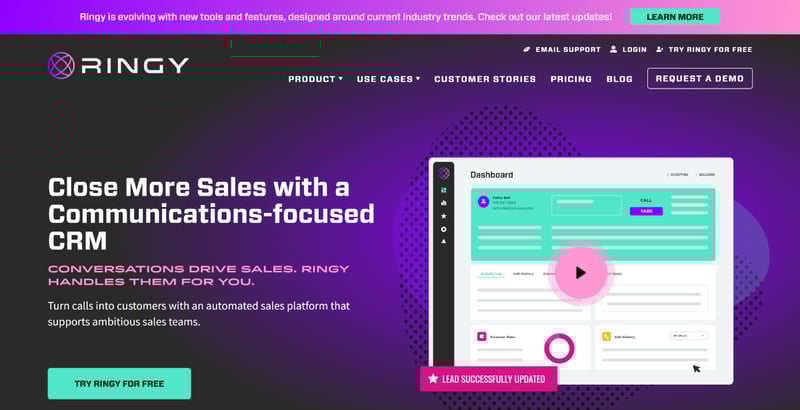
Ringy is a comprehensive, all-in-one CRM and lead generation platform specifically engineered to bridge the gap between generating sales leads and closing deals.
Unlike complex enterprise tools that require months of training, Ringy offers an intuitive interface that combines powerful lead automation with affordable pricing, making it the ideal solution for small businesses looking to scale quickly without breaking the bank.
Here are the key features of Ringy:
- Automated SMS and Email Drip Campaigns: Nurture your leads for small business pipelines automatically by sending personalized text and email sequences that keep prospects engaged 24/7.
- Built-In VoIP Softphone with Call Recording: Streamline communication by calling leads directly from the dashboard, ensuring no data is lost and allowing for easy quality assurance reviews.
- Intelligent Lead Distribution and Routing: Instantly assign incoming small business leads to the most available or qualified sales agent to maximize speed-to-lead and conversion rates.
- Visual Sales Pipeline Management: Track every stage of the customer journey with a clear, drag-and-drop interface that prevents high-value prospects from slipping through the cracks.
Ringy makes it simpler for small businesses to manage their client contacts and expand their customer base because of its intuitive user interface, powerful lead-generating capabilities, and connectivity with well-known communication tools.
Salesforce
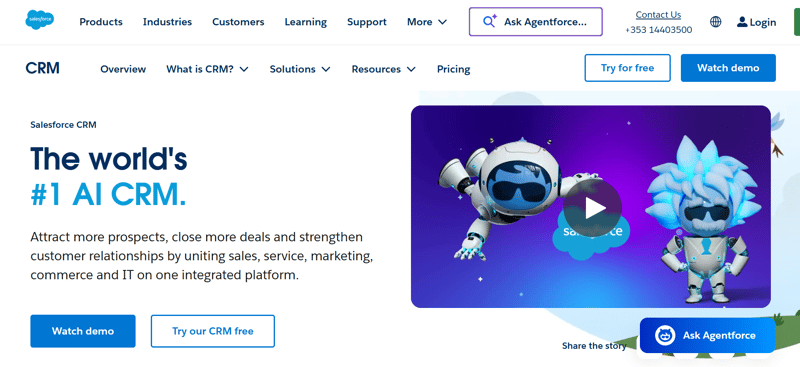
Salesforce is a global leader in cloud-based software, known for its immense scalability and robust ecosystem. While it is often the go-to for massive enterprise corporations with dedicated IT teams, it serves as a powerful option for businesses that require deep customization and have the budget to support a complex infrastructure.
Below are key features of Salesforce:
- Advanced Analytics and Reporting Dashboards: Generate deep insights into sales performance and forecast future trends using complex data modeling tools.
- Highly Customizable Sales Pipelines: Tailor every aspect of the sales process to fit intricate business models, though this often requires significant setup time.
- Extensive Third-Party App Ecosystem: Connect with thousands of other business applications via the AppExchange to create a fully integrated data environment.
Salesforce offers a wide range of other tools and integrations that make it a comprehensive solution for small business lead generation.
HubSpot
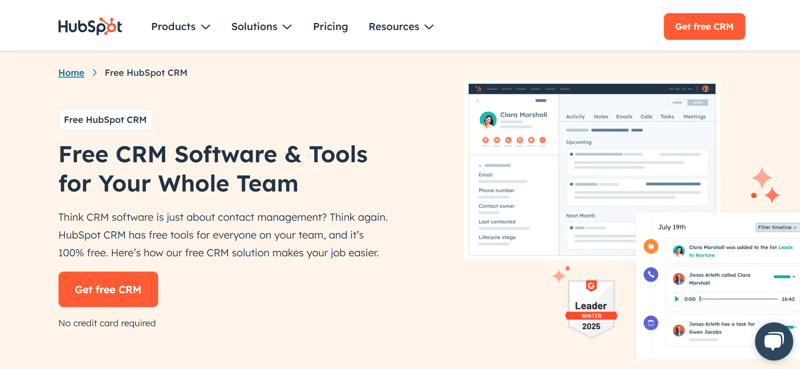
HubSpot is a widely recognized platform that popularized the concept of inbound marketing. It offers a modular approach, allowing users to start with free tools and upgrade to paid "hubs" as they grow. It is a strong contender for content-heavy strategies, though costs can rise steeply as you unlock premium features needed for generating leads for small business at scale.
Here are the key features of HubSpot:
- Marketing Automation Hub: Create workflows that trigger actions based on user behavior, such as downloading an ebook or visiting a specific pricing page.
- Integrated Content Management System (CMS): Build and host blog posts and website pages directly within the platform to centralize your SEO and content efforts.
- Email Tracking and Templates: Receive real-time notifications when a prospect opens an email or clicks a link, helping sales teams time their follow-ups effectively.
With HubSpot, companies can create professional landing pages, capture leads with pop-up forms and lead magnets, score leads based on their likelihood to convert, and nurture leads with automated tools.
Leadpages
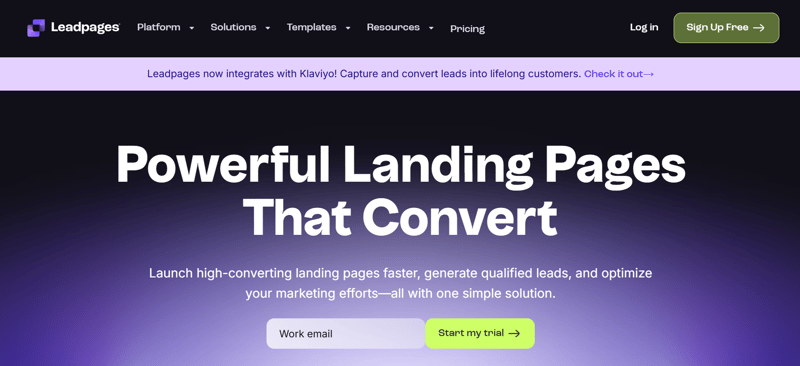
Unlike the full CRM solutions above, Leadpages is a specialized tool focused strictly on the initial capture of leads for business. It excels at building high-converting landing pages and websites but typically requires integration with a separate CRM (like Ringy) to actually manage and nurture the leads once they are captured.
Two key features of Leadpages include:
- Drag-and-Drop Landing Page Builder Create professional-looking landing pages quickly without any coding knowledge, using pre-built templates designed for conversion.
- Conversion Rate Optimization Tools Utilize built-in pop-ups, alert bars, and checkout forms designed to capture visitor information before they leave the site.
- Real-Time A/B Split Testing Test different headlines, images, and layouts against each other to scientifically determine which version generates more opt-ins.
Leadpages is an effective and user-friendly platform designed to help small businesses improve their lead-generation efforts. With its intuitive drag-and-drop interface, Leadpages makes it easy for small business owners to create and launch landing pages, pop-ups, and other lead-generation campaigns quickly and efficiently.
FAQs
What Is the Best Way to Get Leads for a Small Business?
The most effective approach combines organic content marketing with automated outreach. Start by optimizing your website for SEO to capture high-intent traffic. Simultaneously, use lead generation tools for small businesses to run targeted email and SMS campaigns.
Don't rely on just one channel because a hybrid strategy that nurtures prospects through a value-driven funnel ensures a steady stream of small business leads without exhausting your budget on paid ads alone.
How Does a CRM Help With Lead Generation?
A CRM acts as the brain of your sales operation. It centralizes customer data, allowing you to segment audiences and send personalized messages rather than generic blasts.
By automating follow-ups and tracking where prospects are in the funnel, a CRM ensures no opportunity slips through the cracks. It transforms chaotic contact lists into organized leads for business, significantly improving conversion rates and increasing the ROI of your efforts.
Is Lead Generation Software Expensive for Startups?
It doesn't have to be. While enterprise platforms can be costly, there are affordable solutions designed specifically for generating sales leads at the startup level.
Tools like Ringy offer all-in-one features, including VoIP, SMS automation, and pipeline management, at a fraction of the cost of big-name competitors. This allows small businesses to access powerful technology without paying for enterprise bloat, making it a highly cost-effective investment for growth.
Small Business Lead Generation - Conclusion

Small business lead generation can be complex and time-consuming. Still, it can be transformed into a streamlined and effective operation with the right tools and strategies.
By utilizing the best software for small business lead generation, offering value content, using social media, networking and collaborating, optimizing your website, and offering free trials or demos, you can boost your lead generation’s success, grow your support base, and increase revenue.
And when it comes to choosing the right software to manage your small business lead generation, there's no better choice than Ringy.
With its powerful features and user-friendly interface, Ringy makes generating, managing, and tracking leads easy, so you can focus on growing your business.
Request a demo to start maximizing your small business lead generation efforts today with Ringy!

Skyrocket your sales with the CRM that does it all.
Calling? Check. SMS? Check. Automation and AI? Check. Effortlessly keep in touch with your customers and boost your revenue without limits.

Related Articles