 Updated on
 By Carlos Correa
Table of Contents

Over 90% of new life insurance agents quit within their first year. Stretch that stat to five years, and the dropout rate climbs to roughly 95%.
The high turnover rate comes from the industry being fiercely competitive. While it's relatively easy to get licensed (depending on your jurisdiction, it can take anywhere from a few days to a few weeks), sustaining a career is a different story unless you're able to make sales quickly and consistently.
So you may be wondering: "How do insurance agents get leads?"
If you're an agent, you know that strong relationships with existing customers matter. But your bread and butter is new leads, and knowing how to find those new leads is the tricky part.
Key Takeaways
- Technology Supports Your Hustle but Won't Replace It: The best tools for generating leads as an insurance agent work by making your existing efforts faster and more organized, not by doing the prospecting for you. You still need to show up, make calls, build relationships, and follow up consistently.
- Online Platforms Give You More Doors to Knock On: The average person spends over 6.5 hours online daily in 2026. That means your prospects are scrolling LinkedIn, reading Facebook groups, and Googling insurance questions every single day. Agents who build a presence across these channels, through content, community engagement, and paid advertising, create multiple entry points for warm prospects to find them.
- Referrals Remain the Highest-Converting Lead Source Available: According to Nielsen's Global Trust in Advertising report, 88% of consumers trust recommendations from people they know more than any other form of marketing. A simple referral program costs almost nothing to implement but generates prospects who already trust you before you even pick up the phone.
- Your CRM is the Backbone of Every Lead Generation Strategy: Without a system to track, follow up, and nurture your leads, even the best prospecting efforts fall flat. A purpose-built CRM like Ringy helps insurance agents and sales professionals manage every lead from first contact to closed deal, with automation handling the repetitive tasks so you can focus on conversations that actually close.
Online Lead Generation for Insurance Agents

Different lead generation techniques will work for different agents. Factors like the agent's local market, their own personality, sales acumen, specialty (e.g., life insurance or auto insurance), competition, and product knowledge all affect how successful they will be in making sales.
First, let's take a look at different online platforms that you can use:
|
Online Lead Generation Platform for Insurance Agents |
Reasons to Use |
|
|
|
|
Facebook and Facebook advertising |
|
|
Your own website |
|
From here, let's go through some specific tips on how you can capture leads and nurture existing relationships online:
1. Customer Referrals
Don't be afraid to ask your existing customers who are happy with your products or services for referrals. Referral marketing is where you ask your customers to recommend your products or services to people in their circle, whether that be coworkers, family, or friends. Many different types of businesses use referral marketing with success, from B2B SaaS websites to insurance and beyond. A typical strategy is offering an exclusive discount or other benefit to the referrer and the referee so that it's a win-win situation for both parties.
The benefits of a customer referral program are too good to ignore:
- It costs nothing or very little to implement. Customer referrals don't require a big budget. All you really need is some creative thinking about how you'll present the offer to your clients.
- Referred customers have higher retention rates. Customers referred by someone they trust are much more likely to match your ideal client profile and stick with your business longer.
- Higher likelihood of conversion. People trust recommendations from their family, friends, and coworkers. Word-of-mouth referrals remain the single most trusted form of advertising across every age group, with trust levels exceeding 90% among consumers.
2. Purchase Lead Lists
Curated lead lists are a great way to engage with potential customers who have already shown an interest in purchasing the insurance services that you offer. Once you have the leads in your hot little hands, you can start coming up with creative ways to reach out to them.
Typically, this will involve a well-done cold call script that you can use with VoIP calling systems (learn more about what is VoIP) or engaging cold email. Of course, you'll need to incorporate a complete strategy, including follow-ups, to win these customers over.
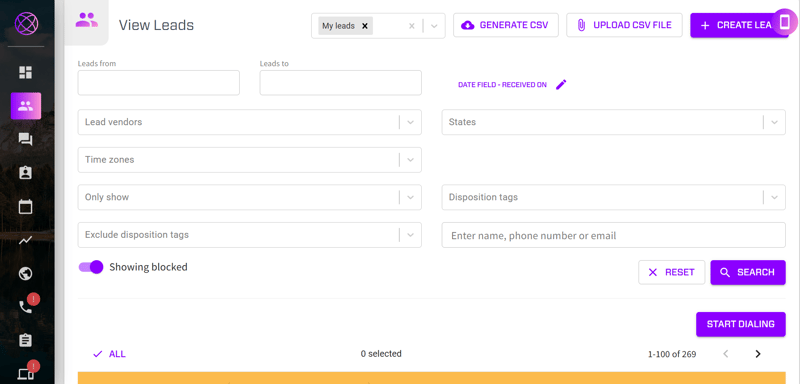
Ringy makes it easy to incorporate your lead lists into the CRM via a .CSV file, through your lead vendor, or manually so you can start engaging with them right away.
3. Build Online Communities
Creating a website and putting content on it on a regular basis is great, but successful insurance sales are also about directly engaging with your customers. Platforms like Facebook and Reddit are great for building online communities.
Creating a Facebook business page (or using your personal one) and joining local Facebook groups and talking directly to your customers is one effective way to insert yourself into the local community. Don't just promote your services, but take the time to answer questions and otherwise present yourself to your customers as a real person rather than just someone who sells insurance.
4. Get listed on Reputable Review Websites
Before anyone buys anything, especially online, they are going to look at reviews. For an important purchase like insurance, you can pretty much be guaranteed that your customers are looking at reviews of you online before they contact you.
Popular review sites that your potential customers are likely to be looking at include:
- Better Business Bureau
- Consumer Affairs
- Yelp
Pay attention to where the majority of your customers are leaving reviews and start with that site as your priority for responding to and directing new reviews. Google Business Profile is often the best starting point because your reviews show up directly in search results when someone searches for your name or business.
5. Host Webinars or Podcasts
A great way to showcase your knowledge and build credibility is by hosting or participating in webinars or podcasts with other professionals. These audio and video pieces can be broadcast live so your audience can ask questions in real time, and they can also be shared afterward through your website and social media channels.
Think of a webinar like hosting a dinner party for prospects. You're providing value (the meal), showing off your personality and expertise (the conversation), and creating a reason for people to come back (the relationship).
Generating Life Insurance Leads Working for a Company vs On Your Own

A common question for new insurance agents is whether it's more beneficial to work for a company or go out on your own.
On the one hand, working for a company is beneficial because they already have the resources and budget in place to generate leads for you. Plus, the company's reputation and existing customers make it easier for you, especially if you are a new agent, to take advantage of them to make more sales.
On the other hand, working for yourself means you don't have to share your profits with anyone else, and you can control every aspect of your work, from which customers you choose to do business with to how many hours you work per day.
The table below compares the pros and cons of working for a company to generate life insurance leads versus going for it on your own:
|
Pros & Cons |
Working at a company |
Freelance insurance sales |
|
Pros |
|
|
|
Cons |
|
|
Essentially, the best course of action is to work for a company to start with so that you can earn a living, build a reputation, and establish credibility with your customers. Once you have a solid customer base and a few years of successful sales under your belt, it may be time to consider moving to freelance insurance sales.
6 Tips on Getting Leads for Insurance Agents

Now that we've covered the basics, here are six practical lead generation tips for insurance agents that you can put to work immediately.
1. Understand Your Target Customer(s)
Depending on the type of insurance you sell, you'll want to attract different types of customers. Take a look at your existing customers, or do some research on the types of customers that typically buy the insurance products you are offering.
For example, the ideal customer for a life insurance policy is likely to be younger professionals rather than older generations, especially for online sales. Young couples and families are good candidates for life insurance and should be on your list for the demographic of customers that you target.
2. Create a Website and Use Contact Forms
Taking advantage of the power of your own website, complete with search-engine-optimized content and lead-generation forms, is essential for insurance agents. With your own website, customers will have a central point where they can easily find the information they need about the insurance products you sell, as well as your contact information.
3. Network with Other Professionals
The professional contacts that you gain throughout your career are important sources of friendship and potential leads. It's important to network with others in the insurance industry, especially with people who sell different types of insurance than what you do, so that you can refer customers to them and they can refer customers to you.
4. Maintain a Social Media Presence
Being active online is important for generating leads for insurance agents for a couple of reasons:
- When potential customers are researching you, they will look at your website, online reviews, and your social media pages to learn more about you. If you don't have a lot of content and information on these sources, then the prospect will likely move on to someone who does.
- Being active on social media helps build your credibility and reputation as an insurance sales professional. It also gives you the chance to interact directly with your existing customers and prospects.
Essentially, social media acts as a hub for communicating with your audience. By maintaining a consistent social media presence, you'll be better able to gain new customers and nurture existing ones.
5. Be Prepared to Handle Objections
A natural part of sales is objection handling. It can be difficult to get objections, especially when you're starting, but just because a customer has a concern doesn't necessarily mean the sale is lost.
Here are some tips for handling sales objections:
- Practice active listening. Your customer wants to be heard, so make sure that you're allowing them to speak before you interject. More importantly, take in what they are saying to ensure you understand their point of view.
- Repeat what you hear. Repeating your prospect's objections back to them in your own words does several things: it clarifies that you understood what they were saying, it demonstrates that you were listening to them, and it helps them feel heard and valued. These are all important for building trust as you work through their objections.
- Validate their concerns. Let your prospect know that you hear them and understand where they are coming from with their concerns. Consider their specific concern and how you can give them some peace of mind that it will be ok. For example, if your prospect is concerned about cost, perhaps you can offer them monthly payment options rather than having to pay all at once. Understanding your prospects' concerns and then offering them a solution is paramount.
- Ask follow-up questions. You want to keep the conversation with your prospect going while obtaining more information. Oftentimes, objections come from a lack of information. If you can continue to ask your prospect open-ended questions, you're likely to uncover information that you can use to turn the objection around.
6. Engage and Follow-Up Using Marketing Automation
Did you know that the longer it takes to respond to a lead, the more likely you are to lose it? An often-cited statistic from Harvard Business Review states that the optimal lead response time for following up on phone calls is five minutes or less, but that was years ago—today, the expected response time is likely much less, considering we have instant communication methods.
If a lead comes in during the middle of the night or while you're helping another customer, you can't respond within five minutes, let alone immediately. However, using marketing automation, you can respond to leads immediately through email or SMS with static messages. These are important for engaging with your lead as soon as possible, even if it's just a message that you'll contact them within a certain time frame.
Why Using a Sales CRM Helps with Leads for Insurance Agents

If you're not using tools like a sales CRM to help you capture and organize your incoming leads, you're missing out on massive productivity savings. Here are the main reasons why you should be using a CRM for your lead management efforts:
Allows Organization of Incoming Leads
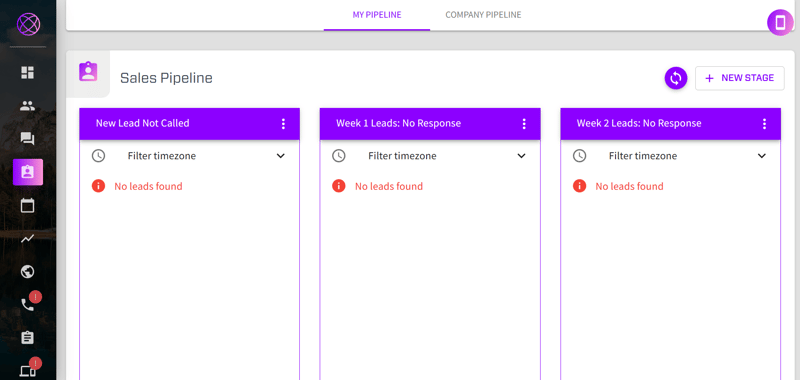
Organizing leads by priority and stage in the sales process is essential for keeping everything on track. If you simply have a big, long list of leads with no organization or structure, it's hard to know whether you've contacted them or not or where they sit in the sales process.
A CRM like Ringy allows you to easily organize incoming leads into priority buckets or categories via the sales pipeline. This lets you easily see which leads you must follow up with first.
Provides Automation Tools
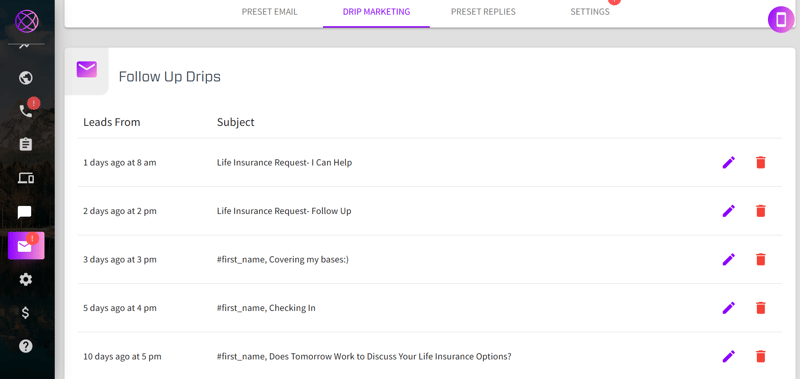
Automating certain aspects of your lead management is a no-brainer. A CRM like Ringy provides several automation tools to help you keep in touch with your customers.
For example, the email drip campaign feature allows you to automatically send an email to a lead when a certain event happens, like they fill in a contact form on your website or sign up for your newsletter.
Meetings and Appointments Can Be Scheduled in the CRM
Instead of having to switch between different applications to schedule and keep track of appointments and meetings for individual leads, a CRM like Ringy allows you to schedule them within the CRM. By integrating with Google Calendar, any updates or changes to appointments or meetings will also be automatically updated in the CRM.
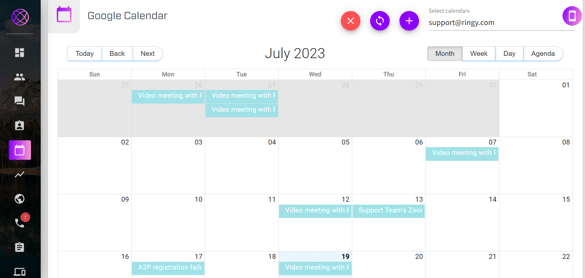
Aside from viewing all of your appointments in the Google Calendar view, you can also view any appointments you have with a lead via their individual dashboard.
Conclusion
Generating leads for insurance agents can be difficult, but by following essential tips and tricks, the process of getting leads can be easier and more efficient.
A CRM helps you effectively manage the leads you do capture, allowing you to prioritize when you contact them and their individual stages in your sales process.
Ringy is an affordable, fully-featured CRM with robust lead management functionality.
Book a Demo with Ringy today to discover how the CRM can benefit your business.

Skyrocket your sales with the CRM that does it all.
Calling? Check. SMS? Check. Automation and AI? Check. Effortlessly keep in touch with your customers and boost your revenue without limits.

Related Articles