
 Updated on
 By Katie Bowman
Table of Contents

Ah, recruiting. It's a task that requires precision, patience, and the right tools. One of the essential tools in a recruiter's arsenal is CRM software.
But with so many options, choosing the right one can be overwhelming. After all, you don't want to invest time and money into a tool that doesn't meet your needs or, worse yet, makes your job harder. So, how do you choose the right CRM software for recruiters?
We'll explore the key factors to consider and the best practices when selecting CRM recruitment software. From candidate tracking to reporting, we've got you covered. So sit back, relax, and get ready to find the CRM software that will take your recruitment game to the next level.
Key Takeaways
- While an ATS handles the "apply-to-hire" process, CRM software for recruiters focuses on long-term engagement and talent mapping, allowing firms to move from reactive to proactive hiring.
- The best CRM recruitment software turns a static database into a "warm" talent bench through candidate segmentation, automated drip campaigns, and historical interaction tracking.
- Modern platforms offer high-value tools such as automated SMS/email sequences, call tracking, and resume parsing, which can boost recruiter productivity by up to 15% and improve placement rates.
- Choosing the right CRM software for recruitment requires a 5-step approach: defining your model, mapping your specific workflow, prioritizing core features, ensuring ease of use, and assessing vendor support.
- High-performing agencies leverage placement analytics and pipeline forecasting to identify their best sourcing channels and coach their teams toward hitting revenue and placement targets.
What Is CRM Software for Recruiters?
CRM software for recruitment is a specialized platform designed to manage and nurture long-term relationships with passive and active candidates, as well as clients.
Unlike traditional databases, CRM recruitment software focuses on engagement through automated communication, talent pooling, and pipeline tracking. It centralizes historical interaction data, allowing recruiters to maintain a "warm" talent bench even when no immediate roles are open.
Recruiter CRM vs ATS: What’s the Difference?
It is a common misconception that an Applicant Tracking System (ATS) and CRM software for recruitment are the same. While they often integrate, they serve distinct purposes:
- ATS (Job-Centric): Focuses on the "apply-to-hire" workflow. It handles compliance, job postings, and interview scheduling for specific, active roles.
- CRM (Relationship-Centric): Focuses on the "source-to-apply" phase. It is built for talent mapping and engagement before a candidate even enters a formal hiring process.
Most high-growth agencies use a combined tech stack architecture. This typically involves a CRM software for recruiters to find and nurture talent, an ATS to manage the legalities of the hire, and integrated communication tools (VoIP/Email) to track every touchpoint.
Benefits of CRM Software for Recruiters

Recruiters juggle many tasks, making it challenging to stay organized and efficient. CRM software for recruiters can help simplify this process by providing various benefits, such as:
1. Centralized Candidate Relationship Management
The core value of CRM software recruitment is the ability to build long-term talent pools rather than relying on one-off applicants.
- Tagging and Segmentation: Group candidates by skill sets, location, or salary expectations.
- Historical Context: View every email, SMS, and call log in one place so you never walk into a conversation "cold."
2. Faster Time-to-Fill and Pipeline Velocity
When a new job order comes in, recruiters with a CRM don't start from scratch. They search their existing warm leads.
- Automated Follow-ups: Keep candidates engaged with "drip" campaigns so they don't forget your brand.
- Stage-based Pipelines: Visually track where candidates sit in the funnel, reducing the "black hole" effect that causes candidate drop-off.
3. Improved Recruiter Productivity
The best CRM recruitment software is designed to eliminate "busy work."
- Automation: Use click-to-call, SMS templates, and automated email sequencing to reach 3x more candidates per day.
- Reduced Context Switching: By integrating with LinkedIn and email providers, recruiters can update records without leaving their browser tabs.
4. Better Client and Hiring Manager Communication
A CRM isn't just for candidates; it manages the "client" side of the equation too.
- Transparency: Shared notes and timelines ensure that if a recruiter is out of the office, a colleague can step in without missing a beat.
- Accountability: Track which hiring managers are slow to provide feedback, helping you manage client expectations.
5. Reporting, Forecasting, and Placement Analytics
Data-driven recruiting is no longer optional. CRM software for recruiters provides high-level insights into:
- Pipeline Health: Are you likely to hit your placement targets this month?
- Source Effectiveness: Which job boards or social platforms are actually providing your highest-quality hires?
- Recruiter Activity: Monitor KPIs like "first-time submittals" and "outreach volume" to coach your team toward better performance.
All these benefits can help companies save time, money, and resources in their recruitment processes.
Key Features of CRM Recruitment Software
So, what are the key features of CRM recruitment software? Here's a quick rundown to help you get started:
|
Feature |
Primary Function |
Business Value |
|
Candidate Tracking |
Monitors the lifecycle from initial lead to final hire. |
Organizes the talent pool and prevents candidates from "falling through the cracks." |
|
Client Management |
Centralizes client data, job orders, and sales activity. |
Strengthens partnerships and streamlines the business development pipeline. |
|
Job Order Management |
Creates and tracks the status of specific openings. |
Provides a clear view of active requirements and submittal progress. |
|
Resume Management |
Stores, parses, and makes resumes searchable. |
Turns a static database into a searchable, high-value asset. |
|
Communication Hub |
Unifies email, SMS, and VoIP logs in one record. |
Ensures a "single source of truth" for every candidate and client interaction. |
|
Automation Tools |
Handles drip campaigns and repetitive tasks. |
Increases recruiter productivity and maintains a "warm" talent bench automatically. |
1. Candidate Tracking
CRM recruitment software enables recruiters to track the candidate's application and hiring process, including resumes, applications, interviews, and hiring status. It helps recruiters keep track of their candidate pool, set reminders for follow-ups, and organize candidate data.
2. Client Management
CRM software for recruiters includes features to manage client relationships, including customer information, job orders, and sales pipeline. It helps recruiters manage client communications, schedule meetings, and keep track of the status of job orders.
3. Job Order Management
This feature enables recruiters to manage job orders, such as creating new orders, managing candidate submissions, and tracking the status of job orders.
4. Resume Management
With this feature, recruiters can manage resumes more efficiently by storing, organizing, and searching through them.
5. Communication Management
CRM software for recruiters enables communication management by centralizing all communication channels, such as email, phone, and text messages, in one place. It helps recruiters keep track of all communications with clients and candidates and enables easy communication through the software.
6. Automation and Workflow Tools
The best CRM recruitment software leverages automation to eliminate repetitive manual entry. By using drip campaigns, recruiters can maintain consistent engagement with passive talent pools without manual intervention.
How to Choose the Right CRM Software for Your Business

Selecting the best CRM recruitment software requires a strategic approach that aligns with your specific operational goals. Since this platform will serve as the heartbeat of your talent acquisition efforts, following a structured evaluation process ensures you invest in a tool that actually drives placements.
Step 1: Define Your Recruiting Model
The first step is recognizing that a one-size-fits-all approach rarely works. An agency focused on executive search requires a CRM software for recruiters that prioritizes deep relationship history and "headhunting" notes, whereas a high-volume staffing firm needs a system optimized for speed, bulk SMS, and rapid-fire screening.
If your business handles contract or temporary placements, your CRM software for recruitment must also support compliance tracking and availability management.
Conversely, in-house teams might prioritize internal mobility and long-term brand engagement over the aggressive sales-to-placement tracking found in third-party agencies.
Step 2: Map Your Recruiting Workflow
Before demoing products, physically chart your current "source-to-placement" lifecycle. Start with how you find a candidate, be it LinkedIn, job boards, or referrals, and follow that journey through initial screening, client submission, and the final offer.
By visualizing these stages, you can identify specific friction points where data gets lost or communication stalls. The goal is to find a CRM recruitment software that mirrors your ideal workflow, effectively acting as a "digital rail" that keeps candidates moving forward without manual intervention at every junction.
Step 3: Evaluate Features That Matter Most
While many platforms offer flashy extras, the best CRM recruitment software wins on core utility. Communication automation is paramount; ensure the system can handle multi-channel drip campaigns for both candidates and clients.
You also need high levels of pipeline flexibility, allowing you to create custom stages for different departments or roles. Reporting depth is another critical factor. Look for dashboards that provide real-time insights into recruiter activity and source effectiveness.
Finally, verify that the CRM software for recruitment integrates seamlessly with your existing ATS, calendars, and the job boards your team uses daily.
Step 4: Prioritize User Adoption and Ease of Use
The most powerful CRM software for recruiters is useless if your team finds it cumbersome to use. A steep learning curve is the primary killer of recruitment ROI. During trials, assess how many clicks it takes to perform basic tasks like adding a new candidate or sending an email.
Mobile usability is also non-negotiable in 2026 and recruiters need to be able to review profiles and respond to messages while on the move. A system that fits naturally into a recruiter's daily habit will see much higher adoption rates and cleaner data entry.
Step 5: Assess Vendor Support and Onboarding
A successful implementation depends heavily on the support provided during the transition phase. Investigate the vendor’s implementation assistance, do they help with data migration from your old spreadsheets or legacy systems?
Beyond the initial launch, you need reliable access to ongoing support, whether through 24/7 live chat, dedicated account managers, or a robust library of training resources. Choosing a vendor that acts as a partner rather than a mere utility provider ensures that as your business scales, your CRM software recruitment capabilities grow alongside you.
Best Practices for Maximizing the Effectiveness of CRM Software in Recruitment

Once you have chosen the right CRM software for recruitment, how do you ensure it's used efficiently and effectively? Remember the following best practices to make the most of your CRM software for recruitment.
1. Ensure Data Accuracy and Completeness
Data accuracy and completeness are essential in any CRM system but are especially critical in recruitment. Recruiting teams rely heavily on candidate data to make informed hiring decisions, so it's essential to ensure that the data in the CRM software is accurate, up-to-date, and complete. Inaccurate or incomplete data can lead to missed opportunities or hiring the wrong candidate, which can be costly for the organization.
For example, a recruiter reviews a candidate's profile in the CRM software and notices their incorrect contact information. The recruiter may miss out on connecting with the candidate, potentially losing them to a competitor.
2. Encourage User Adoption and Training
One of the most common challenges in implementing new technology is user adoption, and CRM software is no exception. To maximize the effectiveness of the software, it's essential to encourage user adoption and provide comprehensive training to users.
To encourage user adoption and training, consider providing hands-on training, creating user guides or videos, and scheduling regular check-ins with users to address any questions or concerns.
3. Integrate the CRM Software with Other Tools
To get the most out of your CRM software for recruitment, it's crucial to integrate it with other tools in your recruitment tech stack. For example, integrating your CRM software with your Applicant Tracking System (ATS) can help streamline your hiring process by syncing candidate data between the two systems, reducing duplicate data entry, and ensuring data accuracy.
Additionally, integrating your CRM software with your email marketing software can help you better engage with candidates, informing them of new job openings and opportunities.
4. Continuously Evaluate and Improve the Process
Like any system or process, there is always room for improvement. To maximize the effectiveness of your CRM recruitment software, it's essential to evaluate and improve the process continuously.
Consider tracking key performance indicators (KPIs), such as time-to-hire, candidate engagement rates, and candidate quality, to identify areas for improvement. Regularly reviewing and analyzing these KPIs can help you identify bottlenecks in your recruitment process and make informed decisions to improve your hiring process continually.
5. Go for Cloud-Based Solutions
Cloud-based CRM software is becoming increasingly popular in the recruitment industry. Cloud-based solutions offer a range of advantages, such as flexibility, scalability, and cost savings.
For example, cloud-based CRM software makes it easier to access candidate data from anywhere, anytime, with just an internet connection. Additionally, cloud-based solutions are generally easier to integrate with other tools in your recruitment tech stack, reducing the manual work involved in setting up integrations.
Overall, cloud-based CRM software for recruiters can help make recruitment processes more efficient and cost-effective.
Top 3 CRM Software for Recruiters
At this point, you already understand the importance of implementing a CRM software for recruitment and how to maximize its effectiveness. Now, let's look at some of the top CRM software for recruiters that you can consider for your organization.
1. Ringy - Streamline the Recruiting Process to Focus On Top Talent
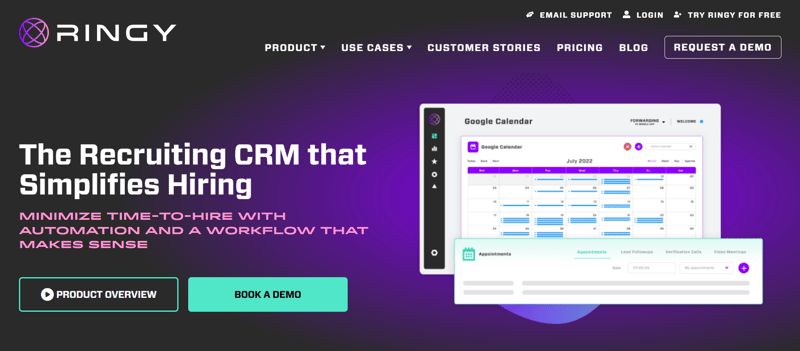
Ringy is a cloud-based solution designed specifically for the recruitment industry, allowing you to streamline your hiring process and focus on top talent.
Our software offers automated workflows to manage candidate relationships, giving you greater visibility into each stage of the recruiting process. Additionally, our intuitive interface allows you to optimize your hiring process and quickly identify top candidates.
Some of the other key features of Ringy include:
|
Features |
Description |
|
Candidate Data Management |
Ringy will enable you to store and manage candidate data such as resumes, cover letters, and job applications in one place. This helps them easily find and access candidate information when needed. |
|
Email and SMS Integration |
With Ringy, you can send emails and SMS messages directly from the platform. This helps them streamline their communication process and saves time. |
|
Ringy automatically logs all incoming and outgoing calls and saves them to the candidate's profile. This helps recruiters keep track of their communications and follow up with candidates easily. |
|
|
Our software also enables recruiters to track the status of their job openings and candidate applications. This helps them stay on top of their recruitment process and manage their workflow more efficiently. |
Overall, Ringy HR and Recruiting makes finding and hiring the best talent easier, streamlining your recruitment process, and improving hiring results.
2. Zoho Recruit
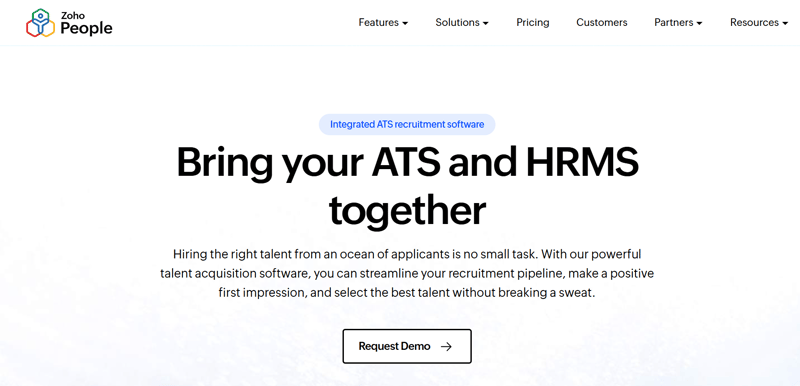
Zoho Recruit is also a cloud-based recruitment software that provides a range of features to help recruiters manage their recruitment process. It has features like applicant tracking, resume parsing, and candidate sourcing.
Some notable features of Zoho Recruit include:
- Resume Parsing: Zoho Recruit automatically parses resumes and extracts candidate information such as name, email, and phone number. This helps recruiters save time and reduce manual data entry.
- Candidate Sourcing: Zoho Recruit enables recruiters to source candidates from various job boards, social media platforms, and other sources. This helps them expand their candidate pool and find the best-fit candidates for their job openings.
3. Trakstar
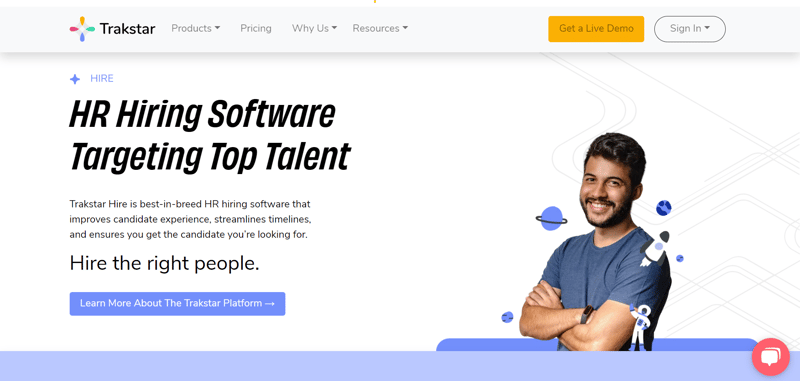
Trakstar is also a cloud-based performance management software designed to simplify recruiting and managing your personnel. With helpful features like applicant tracking, resume parsing, and candidate sourcing available at the click of a button – you can reduce time spent on tedious tasks and focus more on what matters!
Some of the notable features of Trakstar include:
- Performance Management: Trakstar enables recruiters to manage employee performance through ongoing feedback, goal setting, and performance reviews. This helps them identify top performers and improve overall performance.
- Onboarding: Trakstar provides a range of onboarding tools such as new hire forms, orientation checklists, and training resources. This helps recruiters streamline their onboarding process and ensure that new hires are adequately set up.
Common Questions About CRM Software for Recruiters (FAQ)
Navigating the landscape of CRM recruitment software often leads to several technical and strategic questions. Here are the most frequent inquiries from firms evaluating these tools in 2026.
Do recruiters need both a CRM and an ATS?
Most high-growth firms now use both to create a complete talent ecosystem. While an ATS is essential for managing active applications and compliance, CRM software for recruitment focuses on the proactive nurturing of passive candidates and client relationships.
Using both in sync ensures you aren't just filling current jobs but are also building a sustainable "warm" pipeline for the future, effectively moving from reactive to proactive hiring.
How long does it take to implement a recruiter CRM?
For small to mid-sized agencies, a typical rollout of CRM software for recruiters takes between 2 to 9 weeks. This timeline includes pre-implementation planning, data migration from legacy spreadsheets, and team training.
Larger enterprise firms with complex custom workflows or extensive third-party integrations may require 3 to 6 months to reach full production launch, including an adaptation phase to ensure high user adoption across all departments.
Can recruiter CRM software improve placement rates?
Yes, data from 2026 shows that integrated CRM recruitment software can improve placement rates by up to 20%. By using automated drip campaigns and intelligent candidate matching, recruiters can re-engage "silver medalist" candidates, qualified individuals who weren't hired for previous roles but are perfect for new ones. This reduces the time-to-fill and ensures your team spends more time closing deals rather than hunting for fresh leads from scratch.
Is CRM software worth it for small recruiting teams?
Absolutely. Small teams often gain the most from CRM software recruitment because it acts as a "force multiplier." With limited headcount, automation tools handle repetitive outreach and scheduling, allowing a small team to compete with much larger agencies.
Many modern vendors offer "lite" or starter tiers specifically priced for boutique firms, providing enterprise-grade relationship management tools without the massive overhead costs or complex infrastructure requirements.
How much does recruiter CRM software cost?
In 2026, the average cost for CRM software for recruiters ranges from $12 to $200 per user, per month. Entry-level plans for small teams typically start around $15–$30 per user, while enterprise-grade platforms with advanced AI capabilities and deep analytics can exceed $150 per user.
When budgeting, firms should also account for one-time implementation fees and a small reserve (5–15%) for additional data storage or specialized integrations.
Conclusion
Ultimately, the right CRM software for recruiters can help you streamline your recruitment process, reduce manual tasks, and find top talent quickly.
At Ringy, we make it easier for recruiters to manage candidate relationships, automate workflows, and optimize their hiring process. With our intuitive tools and comprehensive features, you can save time and improve your hiring results.
Take the next step towards optimizing your recruitment process with Ringy! Try our software cost-free today and see how it can transform your hiring process.

Skyrocket your sales with the CRM that does it all.
Calling? Check. SMS? Check. Automation and AI? Check. Effortlessly keep in touch with your customers and boost your revenue without limits.